The Pangalanes canals, Toliara and Fort Dauphin
A Madagascar of sea and villages: the east coast along the canals, then the south-west at Toliara and the wild bays of Fort Dauphin, among spiny forests and lemurs.
- Antananarivo
- Andasibe
- Pangalanes Canal
- Toliara
- Fort Dauphin
- Berenty
Day by day
- Day 1
Arrival in Antananarivo
This fifteen-day trip crosses three coasts of Madagascar without taking the long road south: the rainforest of Andasibe with its indri, the Pangalanes canals along the Indian Ocean, the sea at Anakao near Toliara and the wild bays of Fort Dauphin, with the dancing sifakas of Berenty. You travel with a driver, by boat and on three domestic flights.
Before you go: Italian citizens need a passport valid for at least six months on entry, with blank pages, a return ticket and a tourist visa, issued on arrival at the airport or online in advance, between 7 days and 6 months before, on the official e-visa website listed by Viaggiare Sicuri. Other nationalities should check their own rules. After violent protests in late September and early October 2025, a transitional government took office on 17 October 2025: avoid demonstrations and gatherings. There are armed robberies on main roads, especially at night: never travel by road after dark. For the south, the British government reports a tense situation in the triangle between Ihosy, Toliara and Fort Dauphin, advises using a recognised tour operator and travelling to Fort Dauphin by air. On boats, always check life jackets and loads: there have been accidents caused by overcrowding and sudden squalls. Malaria is present: ask your doctor about antimalarials.
You land in Antananarivo, the capital, known to everyone as Tana, built on hills among the rice fields of the highlands.
In the evening, stay at your accommodation or use an official taxi.
Overnight in Antananarivo.
Practical tip: change the ariary you need for the whole trip in the city. On the canals and in the villages of the south there are no cash machines.
- Day 2
Andasibe and the rainforest
Today you leave the capital for the rainforest of the east.
Early in the morning, set off with your driver along the national road heading east. In a few hours you come down from the highlands, past terraced rice fields, villages of red brick houses and fruit stalls, to hills covered in forest. Leave early, so that you have time for the park today.
Andasibe is a small village on the edge of Andasibe-Mantadia National Park. In the early afternoon, enter the park with a local guide, who is compulsory, as Madagascar National Parks requires. Pay for the entry and the guide: check prices and times.
You walk among huge trees, tree ferns, orchids and lianas, looking for the indri, the largest living lemur, black and white, with long legs. Its call, a powerful wail like the song of a whale, can be heard for kilometres. The same forest is home to the diademed sifaka, with orange and grey fur, brown lemurs and many birds found only in Madagascar.
At sunset, go on a night walk with a guide in the community reserves near the park, where visits after dark are allowed. With a torch you find chameleons asleep on the branches, colourful frogs and mouse lemurs, the smallest lemurs of all.
Overnight in Andasibe.
Practical tip: stay silent near the indri and keep the distance your guide tells you. They are endangered animals and very sensitive to disturbance, and a quiet group sees much more.
- Day 3
Towards the Pangalanes canals
Today you go down to the Indian Ocean and board a boat on the canals.
In the morning, if you like, go back to the edge of the forest at dawn to hear the indri sing, then set off east with your driver. The road descends among green hills, banana plantations, lychee trees and wooden villages to the hot and humid coastal plain.
Near the coast, on the shore of a large lake, the boat for the Pangalanes canals is waiting for you. It is a waterway hundreds of kilometres long that runs parallel to the ocean: it links lakes, lagoons and rivers with stretches of canal dug mostly in the French colonial period, between the end of the nineteenth century and the twentieth.
Before leaving, check that the boat has life jackets for everyone, that it is not overloaded and that it has cover from the rain. On the lakes the wind can rise quickly: if the sky darkens, it is better to stop and wait.
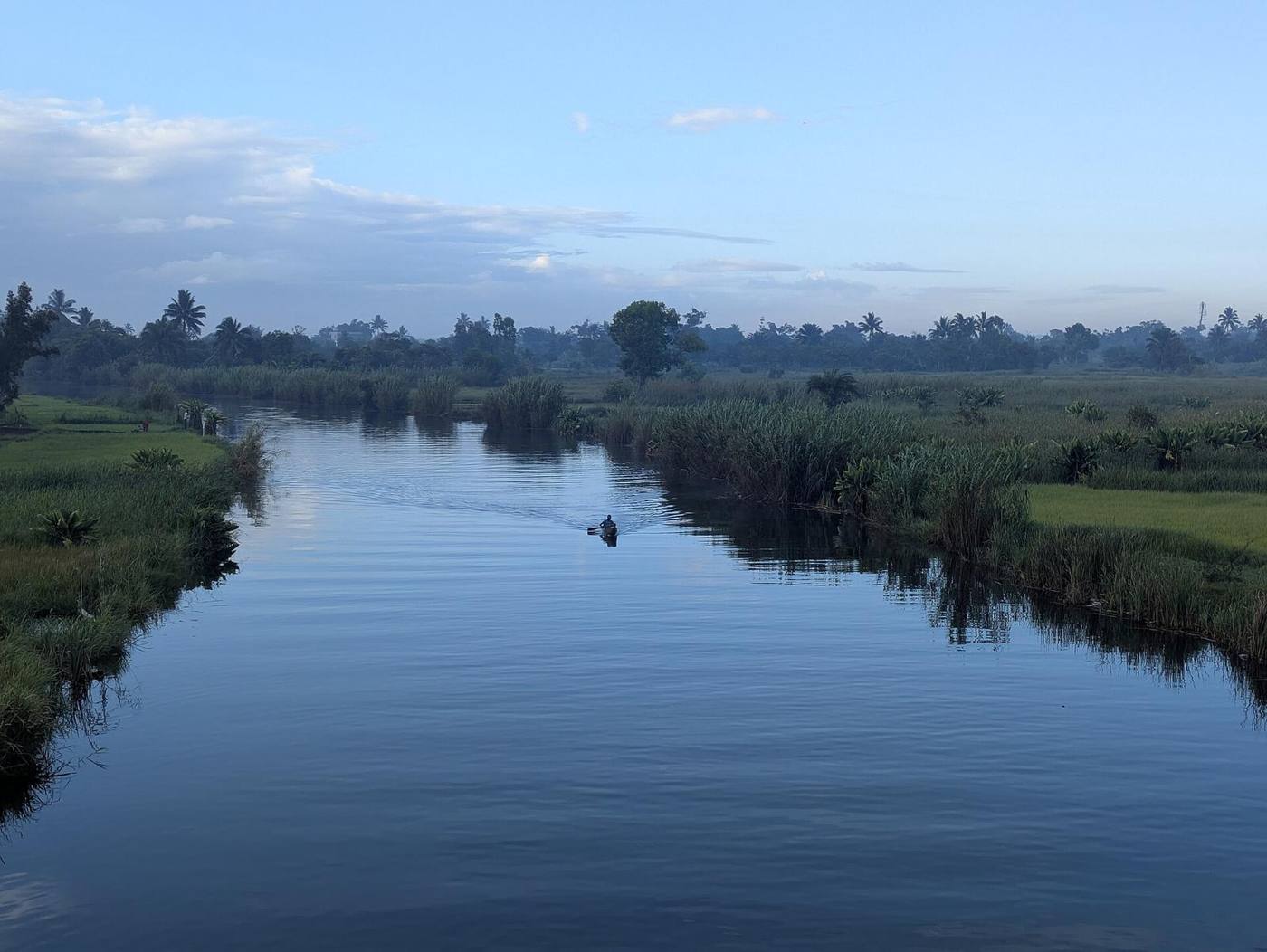
The boat glides past shores of white sand, palm trees, traveller's trees with their fan-shaped leaves and fishing villages. On one side you see the calm lakes, on the other, beyond a strip of sand, you hear the roar of the ocean.
In the afternoon you reach your accommodation on the shore of a lake.
Overnight on the Pangalanes canals, for three nights.
Practical tip: keep your documents, phone and medicines in a dry bag. On the canals rain comes even in the dry season, and boats are not always covered.
- Day 4
Life on the canals
Today you discover how people live along the canals.
The people here are mostly Betsimisaraka, the people of the east coast. For them the canal is a road: pirogues pass loaded with rice, charcoal, fruit and passengers, and children go to school by boat.
In the morning, go out in a pirogue with a guide and a fisherman. You see the traps for fish and prawns, the nets stretched between the reeds and the women washing clothes on the bank. Sit in the middle of the pirogue, keep your life jacket on and do not lean out.
Stop at a village with your guide. The houses are made of wood and palm leaves, raised on small stilts, with plots of cassava and fruit trees. Greet an elder or the village chief first, and always ask permission before taking photos. Many villages have traditional rules, the fady, which your guide explains.
In the afternoon, walk along the strip of sand between the lake and the ocean. The ocean beach is long and wild, but the waves and currents are dangerous and there are sharks in these waters: swim only in the calm spots of the lake that your guide points out.
In the evening, eat lake fish or prawns with rice and coconut sauce, the typical flavours of the east coast.
Overnight on the Pangalanes canals.
Practical tip: bring strong sunscreen and a hat. On the water the glare of the sun burns even when the sky is hazy, and there is little shade on the boats.
- Day 5
Lakes, forests and the ocean
Today is a slow day, to enjoy the lakes and the coast.
Early in the morning, when the water is as smooth as a mirror, take a pirogue ride along the shores. With your guide, look for the lake birds, such as herons, kingfishers and egrets, and watch the fishermen casting their nets by hand.
Then walk along a path in the strip of coastal forest near the lake. Here the forest has been cut down in many areas for charcoal and fields, and what remains is precious. Your guide shows you the plants that local people use as medicine, the orchids and, if you are lucky, a few lemurs.
In the afternoon, rest on the lake shore. If the weather is good, watch from the dune as the light changes over the Indian Ocean.
At sunset the pirogues return to the villages, smoke from the fires rises among the palms and the canals fall silent. It is the most beautiful moment of the day on the Pangalanes.
Pack your bags: tomorrow you leave early to return to the capital, with a long transfer by boat and by road.
Overnight on the Pangalanes canals.
Practical tip: do not buy wild animals, such as chameleons or tortoises, or precious woods. The trade is illegal and damages the forests.
If someone offers you a lemur to hold for a photo, politely say no. Wild animals kept close to people suffer and are often captured illegally.
- Day 6
Back to the capital
Today you return to Antananarivo, on one of the longest travel days of the trip.
At dawn, take the boat back along the canals to the point where your driver is waiting. The lakes are usually calmer in the morning, so it is best to leave early. Today too, check life jackets and loads before boarding.
Then drive back up to the highlands, on the same road as on the way out. The journey takes many hours, with slow lorries, mountain bends and villages to cross slowly. Your driver must plan the day so as to reach the capital before dark. If there are delays, it is better to stop for the night along the way, in Andasibe, than to drive at night.
Along the route, stop at a market to buy fruit: small sweet bananas, lychees between November and January, pineapples and mangoes.
Looking out of the window, you see the landscape change: from the humid coastal plain, with palms and forest, to the cool hills of the highlands, with terraced rice fields and brick houses.
In the evening, in Antananarivo, rest and pack for the south. Tomorrow you take the flight to Toliara.
Overnight in Antananarivo.
Practical tip: confirm the time of tomorrow's flight today, because domestic flights change often. Keep a swimsuit, sunscreen and a mask in a small rucksack, so that you do not have to open your suitcase on the beach.
- Day 7
Flight to Toliara and boat to Anakao
Today you move from the east coast to the south-west, on the Mozambique Channel.
In the morning, take the domestic flight to Toliara, also known by its French name, Tuléar. From the plane you see the green highlands give way to a dry red plain, all the way to the white coast. It is another Madagascar: little rain, spiny forests, baobabs and fishing villages.
Toliara is a hot and dusty town, near the Tropic of Capricorn, with carts pulled by zebu and colourful rickshaws. The British government reports violent robberies on the beaches north and south of the town, even in the daytime: do not walk alone on isolated beaches and rely on your tour operator for all transfers.
From the port, the motorboat leaves for Anakao, a fishing village south of the bay that can only be reached by sea. The departure depends on the tide and the wind: accept the time you are given. Check the life jackets and that the boat is not overloaded, and protect your rucksack in a dry bag.
The crossing passes over the reef, one of the longest coral reefs in the world, with the water changing from deep blue to turquoise.
In Anakao you find very white sand and the outrigger pirogues of the Vezo, the sea people of the south-west, pulled up among the nets.
Overnight in Anakao, for three nights.
Practical tip: bring soft bags. On a boat and on the sand, hard suitcases with wheels are awkward.
- Day 8
Anakao, the reef and Nosy Ve
Today you discover the sea at Anakao, above and below the water.
In the morning, at low tide and with no wind, go out by boat with a local guide to Nosy Ve, the small sandy islet in front of the village. Ask your guide whether you need a ticket to land: check prices and times.
Nosy Ve is famous for its red-tailed tropicbirds, white seabirds with two long red feathers on the tail, which nest here on the ground under the bushes. Walk only on the marked paths, stay a few metres from the nests and keep quiet. The island also has a spiritual value for local people, with traditional rules called fady: respect them.
Around the island, snorkel with your guide. Below the surface you find corals, clownfish in the anemones, parrotfish, starfish and sometimes turtles. Swim slowly and touch nothing, because the reef is fragile and has been damaged by warmer seas and intense fishing. Be careful of the currents away from the shore.
In the afternoon, return to Anakao before the wind makes the sea rough, and rest in the shade.
At sunset, walk along the village beach, among the pirogues and the women cleaning the fish.
Overnight in Anakao.
Practical tip: swim in a long-sleeved T-shirt. The southern sun is very strong and there is no shade on Nosy Ve. Bring water too, because there are no shops on the island.
- Day 9
By sailing pirogue with the Vezo
Today you sail like the fishermen of the south-west.
The Vezo live from fishing and move along the coast following the fish. They use the outrigger pirogue, carved from a single trunk, with a float on one side and a square sail. For them the sea is both home and work.
In the morning, board a sailing pirogue with a fisherman and a guide. You sail slowly, with the wind, inside the lagoon protected by the reef. Sit where you are told, because the balance is delicate, and keep your life jacket on.
Stop at a Vezo village near Anakao. You see the houses of wood and leaves, fish drying in the sun, nets mended by hand and children who paddle from a very young age. Go in only with your guide and greet an elder first.
The south of Madagascar gets very little rain, and drought often hits the people who live inland. Fresh water is precious: use it carefully at your accommodation too.
In the afternoon, have a last swim in the lagoon and rest.
Between July and September, look out to sea: humpback whales pass by, and sometimes you can see their blows even from the beach.
In the evening, eat the grilled catch of the day, or squid caught on the reef.
Overnight in Anakao.
Practical tip: if you want to leave something for the village, ask your guide what is really needed. Do not hand out sweets or money to children, because it encourages them to ask tourists instead of going to school.
- Day 10
Flight to Fort Dauphin
Today you reach the south-eastern corner of the island, where the mountains meet the ocean.
Early in the morning, return by boat to Toliara, at the time set by the tide. Then take the flight to Fort Dauphin: depending on the season's connections, it may be direct or go via Antananarivo. Domestic flights change often: confirm everything the day before and accept that the day may be long.
The British government advises reaching Fort Dauphin by air and not by road, because the area between Ihosy, Toliara and Fort Dauphin remains tense and the roads are in poor condition. That is why this trip uses only flights.
Fort Dauphin, called Tolagnaro in Malagasy, lies on a peninsula between two bays, with green mountains behind it and the Indian Ocean in front. The French built a fort here in the seventeenth century, one of the first European settlements on the island. Today it is a quiet fishing town, with beaches of pale sand.
In the late afternoon, if you arrive in time, walk with your guide along the bay near your accommodation and watch the fishing boats.
Canada reports assaults on Pic Saint Louis, the mountain above the town: do not climb it alone and ask your tour operator for advice.
Overnight in Fort Dauphin.
Practical tip: bring a light jacket. Here the wind blows hard almost all the time and the evenings are cooler than in Toliara.
- Day 11
Lokaro Bay by pirogue
Today you visit Lokaro Bay, one of the most beautiful coastal landscapes in Madagascar.
In the morning, set off north with your guide and driver, on a short track, to a village on the shore of a lake. Here you board a pirogue and cross lagoons and channels surrounded by forests and hills. Keep your life jacket on and your dry bag close.
Along the banks grows a carnivorous plant, the Madagascar pitcher plant, with leaves shaped into small jars that trap insects. Your guide also shows you the traveller's trees and the orchids of the coastal forest.
After the crossing, you walk along a path through the dunes to Lokaro Bay: white sand, clear water, granite rocks and a small island just offshore. Among the rocks there are natural pools where you can swim when the sea is calm. Outside the bay the ocean waves and currents are strong: swim only where your guide says.
Have lunch on the beach, with fish and rice prepared by the fishermen of the village, then rest in the shade.
In the afternoon, return by pirogue and by car to Fort Dauphin, before dark.
Only a few families of fishermen and farmers live in this area, and nature is still untouched in many places. Leave everything as you found it and take your rubbish away with you.
Overnight in Fort Dauphin.
Practical tip: leave early, because the wind rises towards midday and slows down the pirogue crossing on the way back.
- Day 12
Towards Berenty and the spiny forest
Today you leave the green coast and enter the dry south, as far as the Berenty reserve.
In the morning, set off west with your tour operator's driver. Within a few dozen kilometres the landscape changes completely: the humid hills and rainforest give way to an arid plain, with euphorbias, octopus trees and sisal plantations, the plant that gives a fibre for ropes and sacks.
The British government reports that in this part of the south there have been violent incidents involving cattle rustlers, the dahalo: tourists have not been targeted, but you should avoid staying in rural areas without security arrangements. Travel only by day, with your tour operator, and make no unplanned stops along the road.
Berenty is a private reserve on the banks of the Mandrare river, with a forest of large tamarind trees along the river and a stretch of spiny forest. Visit it with the reserve's guide: check prices and times.
In the afternoon, take your first walk. The ring-tailed lemurs, with their tails ringed in black and white, move in groups along the paths and warm themselves in the sun with their arms open, as if they were praying.
At sunset, in the tamarind forest, you see colonies of large fruit bats hanging from the branches.
Overnight in Berenty, for two nights.
Practical tip: do not feed the lemurs, even if they come close. Human food makes them ill and makes them aggressive, and it changes their natural behaviour.
- Day 13
The dancing sifakas of Berenty
Today you see one of the most beautiful sights in Madagascar: the dancing sifakas.
Early in the morning, go out with your guide. Verreaux's sifakas are white lemurs with dark heads that live in the trees. When they have to cross an open space they come down to the ground and move sideways, bounding on their hind legs, with their arms raised for balance. It looks like a dance, and it is the reason many travellers come all the way here.
Walk in silence and keep your distance. In the morning light the white fur of the sifakas stands out against the earth and the dark trunks.
During the day, with your guide, also explore the spiny forest part of the reserve. Here grow plants that exist nowhere else, adapted to months without rain, and there are chameleons, lizards and birds of the south. During the hot hours, rest, because the sun is very strong and even the animals stop.
In the late afternoon, take a last walk, when the ring-tailed lemurs become active again and the sifakas move between the trees for the night.
If the reserve offers it, go out after dark with your guide, along the paths, to see mouse lemurs and nocturnal lemurs by torchlight.
In the evening, listen to the sounds of the forest: crickets, night birds and the rustle of lemurs in the branches.
Overnight in Berenty.
Practical tip: drink plenty of water and bring rehydration salts. In the south the dry heat dehydrates you quickly, even if you do not feel sweaty.
- Day 14
Back to Antananarivo
Today you leave the south and return to the capital, the last stage of the trip.
Early in the morning, if you like, take a last short walk to say goodbye to the sifakas. Then set off again with your driver towards Fort Dauphin, on the same road as on the way out, by day and with no unplanned stops.
From Fort Dauphin, take the flight to Antananarivo. Domestic flights are often delayed or cancelled: that is why the trip includes a night in the capital before your international departure. Always leave at least one day of margin and never book your long-haul flight on the same day as your return from the south.
From the plane, look down on Madagascar one last time: the green mountains of the south-east, then the highlands with their rice fields and red hills scarred by erosion, which have earned Madagascar the name of the great red island.
In the late afternoon, if you arrive early, visit a craft market for your last purchases: raffia baskets, fabrics, wood carvings, vanilla and pepper. Buy only legal products, and nothing made from protected animals or precious woods.
In the evening, stay at your accommodation or use an official taxi, and do not walk around the city after dark.
Overnight in Antananarivo.
Practical tip: keep the receipts for valuable purchases in your hand luggage. When you leave the country, stones and large amounts of vanilla may be checked, and without a receipt you risk losing them.
- Day 15
Departure
Today you leave Madagascar.
In the morning, if your flight is in the afternoon, go up with a driver to the Rova, the queen's palace complex on the highest hill in Tana, with views over the whole city. Check prices and times. Then go to the airport in good time, because traffic is unpredictable.
In fifteen days you have seen three very different coasts of the same country. You heard the indri sing in the rainforest of Andasibe and sailed among lakes and villages on the Pangalanes canals, along the Indian Ocean. Then you swam on the reef at Anakao, saw the tropicbirds of Nosy Ve and sailed in a pirogue with the Vezo. Finally you reached the wild bays of Fort Dauphin and Lokaro Bay, and watched the sifakas dance among the sand and tamarinds of Berenty.
It is a moderate trip, with many boat transfers and three domestic flights whose times can change. It rewards you with landscapes and encounters that few travellers see.
When to go: the best period is from April to November, in the dry season. On the east coast it can rain even in these months, while the south is dry almost all year. From July to September the humpback whales pass by. From December to March it is very hot and there is a risk of cyclones, especially on the east coast.
Practical tip: before you leave, check the Viaggiare Sicuri advice again, because the situation in the south can change quickly.
For those who want to see Madagascar's three coasts without doing the RN7. The sifakas hopping sideways at Berenty are one of the island's finest sights. Madagascar Airlines internal flights are often delayed or cancelled: always leave a spare day before your flight home.
Before you go
- Documents and visa
- Passport valid for at least six months on entry, with blank pages and a return ticket. You need a tourist visa: it is issued on arrival at the airport or online in advance, between 7 days and 6 months before, on the official e-visa website. It is valid for up to 60 days. Declare large sums of foreign currency on arrival.
- Health and vaccines
- Malaria is present, especially on the coasts: ask your doctor about antimalarials. Plague is endemic in some rural areas: use repellent against fleas too. Drink only bottled water. Outside Antananarivo care is limited and serious cases go to South Africa or Réunion: you need insurance covering medical costs and repatriation.
- Money and payments
- Malagasy ariary. Bring euros in cash to change at banks or authorised offices; cards work only in towns and large hotels.
- Power sockets
- Types C and E, 220 volts: you need an adapter for British plugs.
- Time zone
- UTC+3 all year.
- Safety
- After violent protests in late September and early October 2025, a transitional government took office on 17 October 2025; demonstrations can happen again and roads can close at short notice. Armed robberies on main roads, especially at night: never travel by road after dark. For western roads such as the RN35, the British government advises using a recognised operator. Official advice: GOV.UK.
Information checked in November 2026 for Italian and EU citizens. Rules change: always check before you travel.
Variations
Shorter version: 10 days, without the Pangalanes canals, with Andasibe, Anakao, Fort Dauphin and Berenty.
Longer version: add a few days in Ifaty, north of Toliara, for the spiny baobab forest and the reef.
Frequently asked questions
Can you drive to Fort Dauphin?
The British government advises reaching Fort Dauphin by air, because the triangle between Ihosy, Toliara and Fort Dauphin remains tense and the roads are in poor condition. This trip uses only flights.
Are the boats on the Pangalanes canals safe?
In Madagascar there have been boat accidents caused by overcrowding, poor maintenance and sudden squalls. Travel with a recognised tour operator, check life jackets and loads and do not set off in bad weather.
When can you see the dancing sifakas?
In Berenty you can see them all year round, usually early in the morning and in the late afternoon, when they come down to the ground to cross the open spaces between the trees.
Indicative itinerary written by World Atlas. Before booking, check timetables, seasonal openings, documents and safety.
 7 daysModerate
Andasibe and the Avenue of the Baobabs
Indri lemurs in the rainforest and the island's most famous sunset among the baobabs of Morondava.
 15 daysChallenging
Route Nationale 7 to the sea
The great journey south: highlands, lemur forests, the Isalo canyons and the Ifaty coral reef.
 10 daysEasy
Toliara and the south-west reef: Anakao and Ifaty
One of the world's longest coral reefs, Vezo fishing villages, Ifaty's spiny baobab forest and the island of Nosy Ve with its red-tailed tropicbirds.