The Aegean and Lycian coast: Ephesus, Pamukkale and the sea
Greek and Roman ruins, the white terraces of Pamukkale and the turquoise bays between Fethiye and Kaş.
- Izmir
- Ephesus
- Pamukkale
- Fethiye
- Ölüdeniz
- Kaş
- Kekova
- Antalya
Day by day
- Day 1
Arrival in Izmir and transfer to Selçuk
The trip begins in Izmir, Turkey's third city, overlooking a great Aegean gulf. Italian and most EU citizens enter without a visa for tourist stays of up to 90 days in 180; check the rule for your nationality. At Adnan Menderes airport pick up your rental car: for this coastal itinerary it is the most convenient option. Alternatively, a regional train links the airport to Selçuk in about an hour and a half.
Selçuk, about an hour south, is a quiet small town and the best base for visiting Ephesus: it has simple lodgings, a market and everything within walking distance. On the hill above town are the Basilica of St John, built by Justinian on the spot where tradition says the apostle was buried, and the Byzantine fortress. Below, in a field, a single column remains of the Temple of Artemis, one of the seven wonders of the ancient world.
In the afternoon visit the Ephesus Archaeological Museum, small but rich, with the many-breasted statues of Artemis, imperial portraits and objects of daily life found in the excavations: it helps you understand what you will see tomorrow.
In the evening have dinner in central Selçuk. Practical tip: in Turkey you drive on the right; motorways have electronic tolls paid via a tag on the car, so ask the rental company how it works and whether the tag is already fitted.
- Day 2
Ephesus, the House of the Virgin Mary and Şirince
Early in the morning, at opening, enter Ephesus, one of the best-preserved ancient cities in the Mediterranean, a UNESCO World Heritage site. It was a great Greek city and then capital of the Roman province of Asia, with perhaps two hundred thousand inhabitants. The ticket for foreigners costs 40 euros until 31 March 2027, paid in Turkish lira at the day's rate; the Terrace Houses need an extra ticket. It is best to enter from the upper gate and walk down to the lower one along Curetes Street, the marble road.
Along the way you see the Odeon, the Temple of Hadrian, the public latrines, the great Library of Celsus with its two-storey façade, the symbol of Ephesus, and the theatre with almost twenty-five thousand seats, where according to the Acts of the Apostles St Paul preached. Do not skip the Terrace Houses: rich Romans' homes under a protective roof, with mosaics and frescoes.
At midday drive up to the House of the Virgin Mary on Mount Koressos, where according to one tradition Mary spent her last years with the apostle John. It is a place of pilgrimage for Christians and Muslims.
In the afternoon reach Şirince, a Greek village in the hills, with white houses, stone lanes and vineyards, famous for fruit wines. Practical tip: Ephesus has little shade; in summer enter at opening with a hat and plenty of water, and allow at least three hours.
- Day 3
Pamukkale and Hierapolis
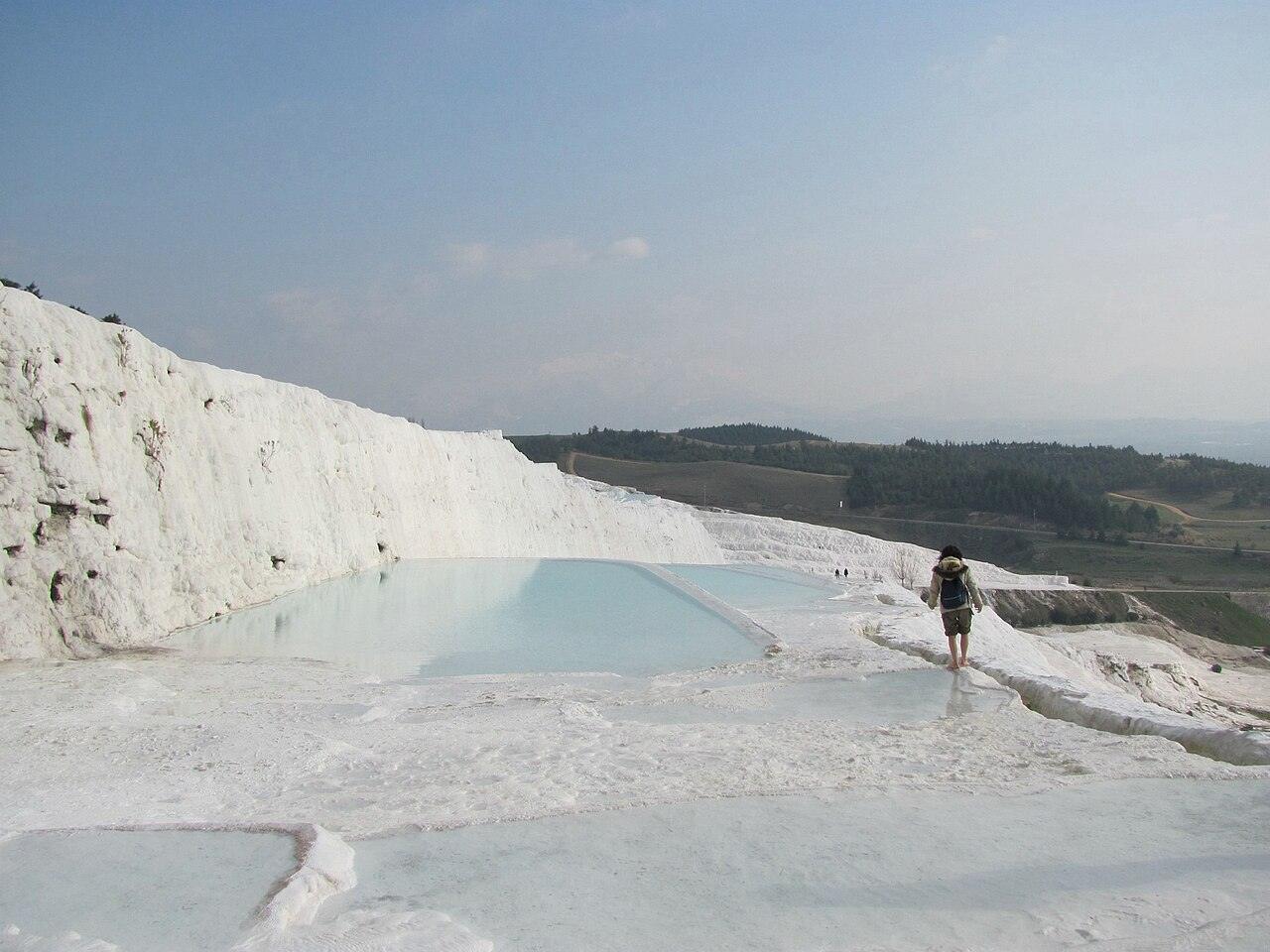
In the morning drive inland to Pamukkale, about three hours. The name means cotton castle: warm spring water, rich in calcium, flows down the hill and deposits carbonate, forming dazzling white terraces and pools of blue water. The site, with the ancient city of Hierapolis, is a UNESCO World Heritage site.
You climb the terraces barefoot to protect the travertine: shoes are forbidden on the limestone. The path is slippery in places and the reflected sunlight is intense, so you need sunglasses. Many pools are now dry or closed to protect the travertine: water is let flow in rotation.
At the top lies Hierapolis, a Greco-Roman spa city founded in the second century BC, where the sick came to be cured by the waters. Visit the great theatre, one of the best preserved in Turkey, the necropolis with hundreds of tombs along the road, the martyrium of St Philip and the Plutonium, a cave that gave off poisonous gas, considered the gate to the underworld.
In the afternoon you can swim in the antique pool, called Cleopatra's Pool, with warm water and fallen Roman columns on the bottom; it is paid separately. Sleep in Pamukkale or around Karahayıt. Practical tip: at sunset the terraces turn pink and the crowds thin out, so it is the best time for photographs.
- Day 4
To Fethiye and the Ölüdeniz lagoon
In the morning drive south through the mountains of the western Taurus to Fethiye on the Mediterranean coast, about three and a half hours. You leave the Aegean and enter Lycia, an ancient region of mountains plunging into a turquoise sea, with Lycian tombs carved into the rocks.
Fethiye is a harbour town with a seafront, a fish market where you choose your fish and have it cooked in the places around, and above the town the Lycian rock tombs from the fourth century BC, carved into the cliff like temple façades. The Tomb of Amyntas, the largest, is reached by a staircase.
In the afternoon go down to Ölüdeniz, about twenty minutes away, Turkey's most photographed lagoon: a spit of white sand enclosing a lagoon of calm turquoise water at the foot of Mount Babadağ. The lagoon is a protected area with a paid entrance; the open beach next to it is at no cost.
At sunset visit Kayaköy, a few kilometres away, a ghost village of stone houses on the hills, abandoned by its Greek population in 1923 with the population exchange between Greece and Turkey. Sleep in Fethiye or Ölüdeniz. Practical tip: in summer the coast is crowded and hot; book accommodation well ahead.
- Day 5
The Twelve Islands by boat or paragliding from Babadağ
Today is a sea day with two options. The first is the boat trip round the twelve islands of the Gulf of Fethiye: every morning wooden boats leave the harbour to tour the bays and islands, with swimming stops in clear water, sometimes near submerged ancient ruins. It is the most relaxing day of the trip. Choose a small boat, quieter than the big party boats with music.
The second option is a tandem paragliding flight from Mount Babadağ, at almost two thousand metres, one of the most famous flying sites in the world: you glide down for thirty or forty minutes over the Ölüdeniz lagoon and land on the beach. You fly with professional, certified pilots; the flight depends on the wind.
Alternatively, walk the first stage of the Lycian Way, the trail of more than five hundred kilometres between Fethiye and Antalya: from Ölüdeniz to Faralya, above Butterfly Valley, a bay enclosed by towering walls reachable only by boat or a steep path.
In the evening return to Fethiye. Practical tip: the sun on the sea is very strong, even when it is windy; use high-factor sunscreen and always carry water. For paragliding book with an agency that shows licences and insurance.
- Day 6
Saklıkent Gorge and Patara beach
In the morning drive inland to Saklıkent Gorge, about an hour from Fethiye, a narrow, deep canyon carved by the river into the mountains. You enter by wading through icy water, even in summer, knee-deep or higher, between walls that close in and rise for hundreds of metres. You can walk a stretch of a few kilometres; further on you need canyoning gear. Wear shoes that can get wet, or rent them at the entrance.
In the early afternoon continue to the coast at Patara, about an hour away, one of Turkey's longest beaches, about eighteen kilometres of golden sand and dunes, a protected area where loggerhead turtles lay their eggs. The beach closes in the evening so as not to disturb them, and umbrellas cannot be placed beyond the marked area.
Behind the beach lie the ruins of Patara, one of the most important cities of the Lycian League, with the restored bouleuterion, the building where the league's council met, the theatre and a long colonnaded street. According to tradition St Nicholas was born here.
Nearby is Xanthos, Lycia's ancient capital, a UNESCO World Heritage site together with the Letoon sanctuary. Sleep in Patara or Kalkan, an elegant seaside town. Practical tip: do not enter Saklıkent after heavy rain because of the risk of flash floods.
- Day 7
Kaş, the white town by the sea
In the morning follow the coastal road to Kaş, one of the most beautiful roads in Turkey, between cliffs and coves. On the way stop at Kaputaş beach, a small bay of pale sand between the rocks at the foot of a canyon, with incredibly coloured water. You descend by a long staircase from the road.
Kaş is a white town of wooden houses with flowered balconies, lanes full of bougainvillea and a small square on the harbour. It is one of Turkey's diving capitals: the water is clear, with caves, walls, wrecks and ancient amphorae. Even with mask and snorkel you see colourful fish near the rocks.
In the afternoon visit the ancient theatre of Antiphellos by the sea at the edge of town, small and perfect for sunset, with a view of the Greek island of Kastellorizo, called Meis in Turkish, a few kilometres away. In town, the King's Tomb, a Lycian sarcophagus on a tall base, stands in the middle of a shopping street.
In the evening Kaş comes alive with small places and the stroll along the harbour. Practical tip: ferries to Kastellorizo in Greece leave from Kaş harbour; you need your passport or identity card and it is wise to check times the day before.
- Day 8
Kayaking over the sunken city of Kekova
Today is the most spectacular day on the Lycian sea. About half an hour from Kaş is the village of Üçağız, from which boats and kayak trips leave for Kekova Island. Along the island's coast, under a few metres of clear water, you see the remains of an ancient city that sank after second-century earthquakes: walls, stairways, house foundations and a harbour. Swimming is forbidden over the protected sunken city; you look from the boat or kayak.
Kayaking with a guide is the finest way to discover it: you paddle slowly over the ruins, with light illuminating the seabed. Trips last half a day.
After the sunken city the boats stop at Kaleköy, ancient Simena, a small village reachable only by sea, with a medieval castle on top of the hill and a Lycian sarcophagus rising from the water in the harbour. You climb to the castle for the view over the islands.
In the afternoon, if you wish, continue to Demre, ancient Myra, with rock tombs carved into the cliff and a large theatre, and the church of St Nicholas, the bishop of Myra from whom the figure of Father Christmas derives. Sleep in Kaş. Practical tip: kayaking is done in calm seas, usually in the morning; the wind often rises in the afternoon.
- Day 9
Antalya, Kaleiçi and the Düden waterfalls
In the morning drive east along the coast to Antalya, about three and a half hours. On the way you can stop at Olympos, with ruins hidden in the vegetation along a river that reaches a beach, and at Chimaera on Mount Yanartaş, where small natural flames burn from the rock because of gas seeping from the ground; they are most striking after sunset.
Antalya is the great city of Turkey's Mediterranean coast, with an old town called Kaleiçi inside the ancient walls: stone lanes, restored wooden Ottoman houses, Hadrian's Gate, a Roman triple arch built for the emperor's visit in 130, and the fluted Yivli minaret, the city's symbol. Below, the old harbour is full of boats.
In the afternoon visit the Antalya Archaeological Museum, among the best in Turkey, with statues from Perge and the sarcophagus hall. Or go to the Düden waterfalls: the upper falls, in a park with paths behind the water, and the lower falls, which drop straight into the sea from a cliff, visible from Lara park or from the sea by boat.
At sunset stroll through Karaalioğlu park, with views of the Taurus mountains dropping into the gulf. Practical tip: in summer Antalya is very hot and humid; see the old town early in the morning and in the evening.
- Day 10
Departure from Antalya
The last day depends on your flight time. Antalya airport is twenty to thirty minutes from the centre and has direct flights to many European cities, as well as domestic flights to Istanbul.
If you have a no-cost morning, visit Perge, about twenty minutes from the city, an ancient Greco-Roman city with a long colonnaded street, baths, a stadium and the Hellenistic towers of its gate. Alternatively, Aspendos, about forty minutes away, has the best-preserved Roman theatre of the ancient world, from the second century, still used for concerts and performances in summer.
If you prefer the sea, take a last swim at Konyaaltı beach, a long pebble beach west of the centre with mountain views, or a boat trip from the old harbour to the Düden falls.
Return the car at the airport. Things to take home: Aegean olive oil, pine honey, ceramics, peştemal towels, spices, lokum and Şirince fruit wines. Practical tip: check the car with the rental company on return and photograph it, to avoid disputes about scratches or damage. Reach the airport at least three hours before international flights, because summer security queues can be long. Keep your passport and the rental receipt handy at the check-in desk.
Ancient history and turquoise sea in ten days, with Ephesus as one of the finest Roman sites in the Mediterranean. Pamukkale is very busy, so arrive at opening time. The boat day among the islands off Fethiye is a great way to rest.
Before you go
- Documents and visa
- Passport, or for some EU citizens a national identity card; no visa for tourism up to 90 days in 180 for most EU nationalities.
- Health and vaccines
- No compulsory vaccines. Drink bottled water. Emergencies: 112.
- Money and payments
- Turkish lira. Cards work almost everywhere; state site tickets are set in euros but paid in lira at the day's rate.
- Power sockets
- Types C and F, 230 volts: the same round-pin sockets as much of Europe.
- Time zone
- UTC+3 all year: Turkey does not use daylight saving time.
- Safety
- The United States rates Turkey level 2, with level 4 within 10 km of the Syrian and Iraqi borders. Tourist areas are busy and calm. Official advice: GOV.UK.
Information checked in November 2026 for Italian and EU citizens. Rules change: always check before you travel.
Variations
In 7 days: Ephesus, Pamukkale, Fethiye with Ölüdeniz and Kaş with Kekova, flying home from Antalya, skipping Saklıkent and Patara.
In 14 days: add a few days on a gulet between Fethiye and Marmaris, or two stages of the Lycian Way on foot between Faralya and Kabak.
Frequently asked questions
How much is Ephesus?
The ticket for foreigners costs 40 euros until 31 March 2027, paid in Turkish lira at the day's rate. The Terrace Houses need an extra ticket.
Can you swim at Pamukkale?
On the travertine terraces you walk barefoot, but many pools are closed to protect them. You swim in the antique pool at Hierapolis, with a separate ticket.
When is the best time for the coast?
May to June and September to October: the sea is warm and there are fewer people. July and August are very hot and crowded, often above 35 °C.
Indicative itinerary written by World Atlas. Before booking, check timetables, seasonal openings, documents and safety.
 7 daysEasy
Istanbul and Cappadocia
The city on the Bosphorus and the fairy chimneys seen from a balloon: essential Turkey in a week.
 15 daysModerate
Grand tour of Turkey
Istanbul, Cappadocia, Konya, the Lycian coast, Pamukkale and Ephesus: the very best in two weeks.
 7 daysModerate
Walking the Lycian Way
Turkey's finest trail: selected stretches between Fethiye and Kaş, with nights in villages and swims in small coves.