Seaside Brazil: Rio, Natal, Pipa and Fernando de Noronha
The north-east's finest beaches: the Natal dunes by buggy, the red cliffs and dolphins of Pipa, and the protected archipelago of Fernando de Noronha.
- Rio de Janeiro
- Natal
- Genipabu
- Pipa
- Fernando de Noronha
Day by day
- Day 1
Arrival in Rio de Janeiro
This journey is Brazil by the sea: three days in Rio de Janeiro, then the north east with the dunes of Genipabu, the cliffs and dolphins of Pipa, and finally Fernando de Noronha, an archipelago in the Atlantic Ocean with some of the most beautiful beaches and waters in the country. You travel by domestic flights and transfers.
Before you go: Italian citizens enter Brazil without a visa for tourism with a valid passport. Other nationalities should check their own rules. The United States rates Brazil at level 2, meaning exercise increased caution, because of crime, and advises against entering favelas, the informal communities, at any time. Ask a travel health clinic about vaccines, such as yellow fever, and use insect repellent against the mosquitoes that carry dengue.
You land at Rio's international airport, about forty minutes from the beach districts, or more in traffic. Rio is one of the most spectacular cities in the world, squeezed between the sea and mountains covered in forest.
In the afternoon settle in Copacabana or Ipanema and walk along the Copacabana seafront, with its black and white wave patterned pavement designed by Roberto Burle Marx.
At sunset go to the Pedra do Arpoador, the rock between Copacabana and Ipanema, where people applaud the sun as it sinks behind the Dois Irmãos mountains.
In the evening try a caipirinha, made with lime, sugar and cachaça, and a fish dish.
Overnight in Rio de Janeiro, for three nights.
Practical tip: take only what you need to the beach, a little cash and a copy of your passport. To get around in the evening, use taxis booked through an app rather than walking along dark streets.
- Day 2
Christ the Redeemer and Sugarloaf Mountain
Today you visit the two symbols of Rio, from above.
Early in the morning go up to Christ the Redeemer, on the summit of Corcovado, about 700 metres above the city. You can get there by the cog railway that climbs through the Tijuca forest, or by the authorised vans. The statue, inaugurated in 1931, spreads its arms over Guanabara Bay, the beaches, the Rodrigo de Freitas lagoon and Sugarloaf Mountain. Check prices and times, and go early, before the clouds and the crowds arrive.
For lunch try feijoada, the black bean stew with pork, served with rice, farofa, toasted cassava flour, and oranges. In Rio it is eaten above all on Saturdays.
In the afternoon go to Urca and take the Sugarloaf cable car, in two stages: first to the Morro da Urca, then to the top of Sugarloaf, about 400 metres above the sea. From up there you see Copacabana, the mouth of the bay, the centre, the bridge to Niterói and the Christ on the mountain opposite. Check prices and times on the official website.
Stay until sunset, when the lights of the city come on.
In the evening have dinner in the Botafogo or Leblon district.
Overnight in Rio de Janeiro.
Practical tip: look at the webcams or the sky before going up to the Christ. If the summit is in the clouds, change the order and go to Sugarloaf first.
- Day 3
Santa Teresa, Lapa and the centre
Today you discover the historic centre and the hillside districts.
In the morning visit the centre, with the Theatro Municipal, inspired by the Paris Opéra, the Biblioteca Nacional and the Praça Floriano. Then go to the renovated port area, with the Boulevard Olímpico, its huge murals and the Museu do Amanhã, the museum of tomorrow, a white futuristic shape on the water. Check prices and times.
At midday go up to Santa Teresa, the bohemian district on the hill, with its colonial houses, artists' studios and steep streets. You can get there on the bonde, the historic yellow tram that runs over the Arcos da Lapa, the old white eighteenth century aqueduct.
In the afternoon walk down the Escadaria Selarón, the staircase covered in coloured tiles from all over the world, laid by the Chilean artist Jorge Selarón.
In the evening go to Lapa, the samba district, with live music and people dancing. On Fridays and Saturdays the streets are full until late.
If you prefer nature, swap the afternoon for the Jardim Botânico, the botanical garden founded in 1808, with its avenue of imperial palms and its orchids.
Overnight in Rio de Janeiro.
Practical tip: in Lapa and the centre in the evening stay in busy streets, keep your phone in your pocket and go back by a taxi booked through an app. Do not follow anyone towards the favelas, even if they offer you a visit.
- Day 4
Flight to Natal
Today you leave Rio and fly to the north east of Brazil.
In the morning have a last swim at Ipanema or Leblon, or walk around the Rodrigo de Freitas lagoon, with the mountains reflected in the water.
Then take the flight to Natal, about three hours. Natal, the capital of the state of Rio Grande do Norte, is a city of dunes and beaches on the north eastern tip of South America, with sunshine almost all year and a constant wind.
In the afternoon visit the Forte dos Reis Magos, a star shaped Portuguese fortress built at the end of the sixteenth century at the mouth of the Potengi river, on the beach. Check prices and times. From there you see the Newton Navarro bridge, long and suspended high above the river.
At sunset go to Ponta Negra, the city's most famous beach, closed to the south by the Morro do Careca, a great sand dune rising above the sea. You cannot climb it: it is protected.
In the evening try carne de sol, salted sun dried beef, with fried cassava and grilled coalho cheese, and prawns, very common on this coast.
Overnight in Natal, in Ponta Negra, for one night.
Practical tip: in the north east the sun is very strong, even when the wind makes you feel cool. Apply sun cream several times a day and drink plenty of coconut water, sold on every beach from carts and kiosks.
- Day 5
The dunes of Genipabu by buggy
Today you do Natal's most famous excursion: the dunes of Genipabu by buggy.
In the morning head north, cross the bridge over the Potengi river and reach Genipabu, about half an hour away. Here dunes of golden sand run down to the sea and to freshwater lagoons. You climb into a buggy, a small open car for the sand, driven by a local driver.
You can choose the gentle ride or the one called com emoção, with emotion, with steep descents and bends on the sand. You stop to look at the view from the highest dunes and at the Genipabu lagoon, where you can take a dromedary ride.
Further north, at the Jacumã lagoon, you try the aerobunda, a zip line that slides you down seated into the water, and the skibunda, sliding down the dune on a board. Then swim in the warm water.
For lunch eat grilled fish in one of the shacks on the lagoon or the beach.
In the afternoon you return to Natal and continue south to Pipa, about an hour and a half. On the way stop at Pirangi do Norte to see the cajueiro, considered the largest cashew tree in the world, with branches covering a huge area. Check prices and times.
Overnight in Pipa, for four nights.
Practical tip: choose only an authorised buggy driver, with the permit on display, and ask for a seat belt. Protect your phone and camera from the sand with a plastic bag.
- Day 6
Pipa and the Baía dos Golfinhos
Today you discover Pipa, a fishing village that has become one of the best loved seaside resorts in Brazil.
Pipa sits above high red and orange cliffs, with the Atlantic forest reaching down to the sea. The streets are full of small places to eat, colourful houses and craft shops.
In the morning, at low tide, walk from the Praia do Centro along the shore to the Baía dos Golfinhos, the bay of dolphins, enclosed by cliffs. Here dolphins often come close to the shore, especially early in the morning. Swim quietly and do not try to touch them: they are wild animals.
At high tide the beach disappears, so check the tide times and get back in time. You can also see the dolphins from a boat leaving the village harbour.
For lunch try tapioca, a kind of crêpe made from cassava starch filled with cheese, coconut or meat, and a tropical fruit juice such as acerola, cashew fruit or mango.
In the afternoon go up to the Chapadão, the viewpoint above the cliffs, with the view over the Praia do Amor, a curving beach loved by surfers, and the blue sea.
In the evening walk along the village's main street, full of people, music and stalls.
Overnight in Pipa.
Practical tip: in Pipa download a tide app or ask at your accommodation. Many beaches at the foot of the cliffs can only be reached at low tide, and at high tide you can get stuck.
- Day 7
The beaches and cliffs of Pipa
Today you explore the beaches around Pipa, each one different from the next.
In the morning go to the Praia do Madeiro, next to the bay of dolphins, a long, calm beach with regular waves, ideal for a first surf lesson or for bodyboarding. From the cliff above the beach you go down a wooden staircase.
Then walk south to the Praia das Minas, at the foot of high cliffs, where sea turtles lay their eggs in some months of the year. If you see a marked nest, do not go near it.
For lunch have a fish dish with pirão, a cream of cassava flour cooked in fish stock.
In the afternoon try stand up paddleboarding or kayaking along the coast, or take a walk in the Atlantic forest above the cliffs, with paths and viewpoints over the sea. Tropical birds, small marmosets and lizards live here.
At sunset go back to watch the sea from the Chapadão or from the cliff above the Praia do Amor, when the red rocks turn almost purple.
In the evening try moqueca, the fish stew with coconut milk and palm oil, and caipirinhas made with tropical fruit.
Overnight in Pipa.
Practical tip: there are sometimes strong currents on the beaches of Pipa. Swim where others are swimming and where there is a lifeguard, and ask the surfers whether the sea is safe.
- Day 8
The Guaraíras lagoon and Tibau do Sul
Today you discover the Guaraíras lagoon and the quieter coast north of Pipa.
In the morning go to Tibau do Sul, the town that gives its name to the municipality, a few kilometres from Pipa, where the Guaraíras lagoon meets the sea. The lagoon is surrounded by mangroves, palms and dunes, and the water is calm and warm.
Take a kayak or boat trip among the mangroves, where you see crabs, herons and fishermen with their nets. In some places you can step onto sandbanks in the middle of the water and swim.
For lunch try prawns or crab, cooked simply with garlic and butter, or caranguejada, boiled crabs that you crack open with a little hammer.
In the afternoon, if you want to see more beaches, continue by buggy south to Barra do Cunhaú, a coast of dunes, fishing villages and long, almost empty beaches.
At sunset return to Tibau do Sul. On the hill above the lagoon, called the Mirante, there is a viewpoint where people gather to watch the sun go down over the water. It is one of the most beautiful sunsets on the coast.
In the evening go back to Pipa for dinner.
Overnight in Pipa.
Practical tip: in the lagoon and the mangroves the mosquitoes make themselves felt at sunset. Put on repellent before you go out and wear a light long sleeved top.
- Day 9
A slow day in Pipa
Today is a slow day, to enjoy Pipa without hurrying before the island.
In the morning go back to the Baía dos Golfinhos at dawn, when the beach is almost empty and the dolphins are easier to see. Then have breakfast with tropical fruit, tapioca and a fresh juice.
For the rest of the morning try an activity you have not done yet: a surf lesson at the Praia do Madeiro, a horse ride on the beach, or a yoga class on the cliff, very popular in the village.
For lunch have an açaí, the cream of Amazonian berries served cold with banana and granola, a light, refreshing meal.
In the afternoon rest in the shade or shop for local crafts: wooden objects, straw bags, colourful hammocks and bottles of coloured sand, a tradition of the region, with designs made by hand inside the glass.
Then prepare for the departure to Fernando de Noronha: make sure you have paid the island's environmental tax online and have the confirmations printed or on your phone.
In the evening have your last dinner in Pipa, perhaps grilled fish and a caipirinha.
Overnight in Pipa.
Practical tip: on Fernando de Noronha everything costs more and there are few cash machines. Bring some cash in reais, but above all a card that works well in Brazil, and tell your bank before you travel.
- Day 10
Flight to Fernando de Noronha
Today you reach Fernando de Noronha, a volcanic archipelago in the middle of the Atlantic.
In the morning travel back from Pipa to Natal airport, about an hour and a half or two, and take the flight to the island, about an hour. From the window you see the blue ocean and then the green island with the Morro do Pico, the highest point, a great tower of rock.
Fernando de Noronha lies about 350 kilometres off the coast and is made up of around twenty islands. Most of the archipelago is a national marine park and, together with the Rocas atoll, it is a UNESCO World Heritage Site. Visitor numbers are controlled.
On arrival you show the receipt for the Taxa de Preservação Ambiental, the environmental tax paid for every day of your stay. Check the current amount on the island's official website and pay it online before you leave. For the park beaches you also need the national marine park ticket: on the park's official website it costs 393 reais for foreign visitors and is valid for ten days; Brazilians get a discount. Check before you go whether it has changed.
In the afternoon walk around the Vila dos Remédios, the historic village, with its white church and the ruins of the Portuguese fort.
At sunset go to the Forte do Boldró, from where you watch the sun sink behind the islands.
Overnight on Fernando de Noronha, for five nights.
Practical tip: on the island the clock is one hour ahead of Rio and Natal. Remember this for flights and trail bookings.
- Day 11
The Baía do Sancho and the Baía dos Porcos
Today you visit the island's most famous beaches.
In the morning collect your park ticket at the Boldró visitor centre and book the trails with limited numbers for the coming days.
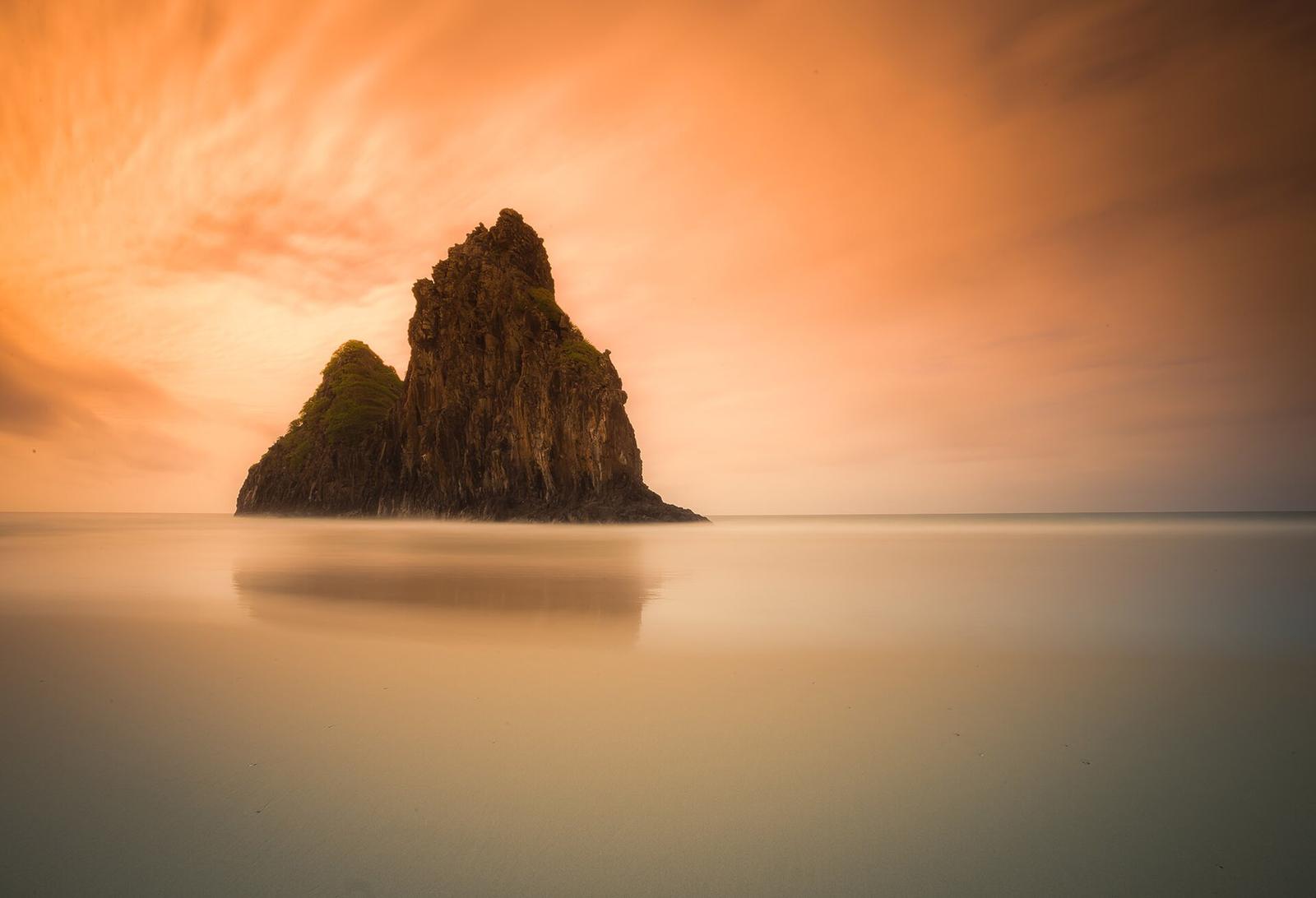
Then go to the Baía do Sancho, often considered one of the most beautiful beaches in the world. To get down you climb through a narrow iron ladder inside a cleft in the rock, then another ladder, to the golden sand at the foot of a cliff covered in vegetation. The water is turquoise and clear: with mask and snorkel you see colourful fish, rays and sometimes turtles. You can also arrive by sea, on the boats.
In the middle of the day walk to the Baía dos Porcos, a small bay with natural pools among black rocks and the view of the Morro Dois Irmãos, two twin hills rising from the sea, the symbol of the island. Go at low tide.
In the afternoon stop at the viewpoint over the Baía dos Golfinhos, above the bay where spinner dolphins live, leaping and spinning in the air. No swimming here: the bay is protected for the animals.
In the evening have dinner in the Vila dos Remédios.
Overnight on Fernando de Noronha.
Practical tip: in the Atalaia natural pool sun cream is banned, and ordinary sun cream harms marine life in general. Bring one suitable for the marine environment and a long sleeved swim top.
- Day 12
Snorkelling with turtles at Sueste
Today you swim with sea turtles.
In the morning go to the Praia do Sueste, a wide, calm bay on the side of the island facing the mainland, called the outer sea. Here the shallow water and the seagrass meadows attract green turtles, which graze peacefully on the bottom. With mask and snorkel you swim beside them, and you often also see rays and small sharks, harmless if you keep your distance.
On this beach the park organises swimming with clear rules, often with a life jacket and an area set aside for snorkelling. Listen to the staff's instructions.
For lunch try peixe na telha, fish cooked on a terracotta tile with vegetables, one of the island's typical dishes.
In the afternoon go to the Praia do Leão, a wild beach with stronger waves and two rocks in the sea shaped like a sea lion. Turtles come here to lay their eggs in some months; follow the signs and do not walk on the marked areas.
At sunset join an evening talk about turtles and the island's marine life, organised by the local conservation projects.
Overnight on Fernando de Noronha.
Practical tip: never touch the turtles and never feed them. Keep at least a few metres away and never place yourself between the animal and the open sea.
- Day 13
Diving and a boat trip
Today you discover the island from the sea.
In the morning go scuba diving. Fernando de Noronha is one of the best diving areas in Brazil, with warm water and visibility that is often excellent. If you have no certificate you can do a try dive, a first dive accompanied by an instructor, in shallow water. You see tropical fish, rays, moray eels, turtles and sometimes sharks.
If you would rather not dive, try plana sub, in which a boat slowly tows you on a board while you look at the seabed underwater with a mask.
For lunch go back to the Santo Antônio harbour and eat something near the pier.
In the afternoon take the boat trip along the inner sea, the north side of the island, towards the Baía dos Golfinhos: from the boat you see the spinner dolphins swimming alongside the hull, the Baía do Sancho from the sea and the cliffs. The boat often stops for a swim with a mask.
At sunset go to the Praia do Cachorro or the Praia da Conceição, beneath the Morro do Pico, and watch the sun go down over the sea.
Overnight on Fernando de Noronha.
Practical tip: do not go scuba diving in the 24 hours before your flight home, because the change in pressure on the plane can be dangerous. Plan your dives for your first days on the island.
- Day 14
The clifftop trails
Today you walk along the cliffs and the natural pools, the most fragile places on the island.
In the morning, at low tide, go to the Atalaia natural pool, a rock pool full of colourful fish, small sharks and octopuses. Entry is limited, with a guide, for a short time and without sun cream, so you must have booked it at the visitor centre. If there are no places, ask about the other trails.
You can also do one of the clifftop trails that the park runs with a guide, such as the Capim Açu, along the wild coast with views over the sea, or the Pontinha Caieira, towards the more hidden beaches. Book ahead and ask about the length and difficulty.
For lunch rest and eat a tropical fruit salad or a fish sandwich.
In the afternoon tour the island by buggy: the only paved road crosses the island from the harbour to the Praia do Sueste. Stop at the viewpoints and at the Praia do Boldró.
At sunset go back to the Forte do Boldró or to the viewpoint over the Morro Dois Irmãos for your last evening on the island.
In the evening have a farewell dinner with the catch of the day.
Overnight on Fernando de Noronha.
Practical tip: on the trails wear closed shoes with non slip soles, and bring water and a hat. Wet rocks covered in seaweed are very slippery.
- Day 15
Back to Natal
Today you leave the island and return to the mainland.
In the morning have a last swim at the Praia da Conceição or the Praia do Porto, near the village, where with a mask you see colourful fish among the rocks close to the shore. If you have time, say a last goodbye to the Morro Dois Irmãos from the viewpoint above the Baía dos Porcos.
Then take the flight to Natal, about an hour. Remember that on the mainland the clock goes back one hour.
In the afternoon settle in Ponta Negra or in the area of Natal's city beaches and rest. If you still want to see something, visit the Parque das Dunas, a large reserve of dunes covered in Atlantic forest in the middle of the city, with guided trails. Check prices and times before you go.
Alternatively go to Natal's craft market, where you find handmade lace, hammocks, coconut products, cashew nuts and bottles of coloured sand.
In the evening walk along the lit Ponta Negra seafront and have camarão, prawns, cooked in a pumpkin or with coconut milk, a speciality of Natal.
Overnight in Natal, for two nights.
Practical tip: always keep a spare day before your international flight. Flights from the island can be delayed by the weather or by airline schedule changes.
- Day 16
Spare day in Natal
Today is a spare day, useful if your flight from Noronha was moved, or to use for one last excursion.
In the morning, if everything went well, head south to the beaches of Cotovelo and Pirangi, with the natural coral pools off the coast. At low tide boats take visitors out to the coral banks, where you snorkel in shallow water among colourful fish.
Alternatively go north to Maracajaú, about an hour and a half from Natal, where a coral reef a few kilometres offshore forms the parrachos, large natural pools in the open sea. Check the tides before booking: at high tide you cannot see well.
For lunch try ginga com tapioca, small fried fish inside tapioca, a typical Natal snack, or a plate of carne de sol with manteiga de garrafa, the clarified butter of the north east.
In the afternoon rest on the beach or by the pool and pack your bags for the journey home.
In the evening have a last Brazilian dinner, with fish, prawns and a dessert such as cocada, the sweet made of coconut and sugar.
Overnight in Natal.
Practical tip: before buying souvenirs made of shells, coral or feathers, remember that many are banned by law in Brazil or in Europe. Choose objects made of wood, fabric or ceramic instead.
- Day 17
Departure from Natal
Today you leave Brazil.
In the morning, if your flight is late, take a last walk in Ponta Negra or have a last swim, and buy cashew nuts and craft cachaça to take home.
Then head to Natal airport, about an hour from Ponta Negra, and take your flight home, often with a stop in São Paulo, Rio or Europe.
In these seventeen days you have seen Brazil by the sea: Christ the Redeemer, Sugarloaf Mountain, the beaches of Copacabana and Ipanema and the districts of Santa Teresa and Lapa in Rio, the dunes of Genipabu by buggy, the red cliffs and dolphins of Pipa, the Guaraíras lagoon, and Fernando de Noronha, with the Baía do Sancho, the turtles of Sueste, the spinner dolphins and the natural pools.
When to go: the best months are from September to February, with sunshine, calm seas and the best visibility for snorkelling. From March to July it rains more on the north east coast. In Rio the summer, from December to March, is very hot and humid; Carnival, in February or early March, makes everything more expensive and crowded.
Practical tip: in Brazil restaurants often include a ten per cent service charge in the bill, called serviço. Check the receipt before leaving an extra tip. For guides and drivers a small tip is always appreciated.
Brazil for those seeking the finest sea. Fernando de Noronha has limited access and a daily environmental fee that makes a stay expensive: even three nights are enough to see why it's called one of the world's most beautiful islands. Best months: September-February.
Before you go
- Documents and visa
- Valid passport; no visa for tourism up to 90 days for EU citizens.
- Health and vaccines
- No compulsory vaccines arriving from Europe; yellow fever is recommended for the Amazon and some inland areas. Protect yourself against mosquitoes because of dengue. Emergencies: 190 police, 192 ambulance, 193 fire.
- Money and payments
- Brazilian real. Cards and instant payments are everywhere; carry little cash.
- Power sockets
- Type N, plus C, 127 or 220 volts depending on the city: check the voltage before plugging in devices.
- Time zone
- Rio and São Paulo are UTC-3 all year: Brazil does not use daylight saving time.
- Safety
- The United States rates Brazil level 2 for crime, with level 4 within 160 km of land borders (except Foz do Iguaçu and the Pantanal). No favelas without a community guide. Official advice: GOV.UK.
Information checked in November 2026 for Italian and EU citizens. Rules change: always check before you travel.
Variations
In 12 days: Rio de Janeiro and Fernando de Noronha, with three nights on the island and flights via Recife or Natal, without Pipa and Genipabu.
In 21 days: add Recife and Olinda, the colonial town listed by UNESCO, and a few days in Porto de Galinhas, with its natural pools.
Frequently asked questions
What document do you need for Brazil?
Italian citizens enter Brazil without a visa for tourism with a valid passport. Other nationalities should check their own rules.
How much does Fernando de Noronha cost?
You pay the environmental tax for every day of your stay: check the current amount on the island's official website and pay it online. For the park beaches you also need the national marine park ticket, which on the official website costs 393 reais for foreigners and is valid for ten days. Accommodation and meals are expensive.
Is Brazil safe?
The United States rates Brazil at level 2, meaning exercise increased caution, because of crime, and advises against entering favelas. In Rio do not show off your phone or jewellery, use taxis booked through an app in the evening and take only what you need to the beach. Fernando de Noronha and Pipa are quiet places.
Indicative itinerary written by World Atlas. Before booking, check timetables, seasonal openings, documents and safety.
 7 daysEasy
Rio de Janeiro and the Iguaçu Falls
South America's most spectacular city and its mightiest falls, seen from both sides of the border.
 15 daysModerate
Pantanal, Amazon and Rio
The jaguars of the Pantanal, a lodge in the Amazon rainforest and a finale in Rio de Janeiro.
 12 daysEasy
Brazil express: Rio, Iguaçu and Salvador da Bahia
Postcard Brazil in under two weeks: Sugarloaf Mountain, the world's mightiest falls and the most African city in the Americas.