Azerbaijan and Georgia, from Baku to the Black Sea
From the Caspian to the Black Sea across the southern Caucasus: Baku and Sheki, then Kakheti, Tbilisi, Vardzia, Svaneti and Batumi.
- Baku
- Gobustan
- Sheki
- Signagi
- David Gareja
- Tbilisi
- Kazbegi
- Vardzia
- Ushguli
- Batumi
Day by day
- Day 1
Arrival in Baku and the old city
This fourteen-day trip crosses the South Caucasus from the Caspian Sea to the Black Sea: Baku, Gobustan and Sheki in Azerbaijan, then in Georgia Kakheti, the monasteries of David Gareja, Tbilisi, Kazbegi, Vardzia, Svaneti and Batumi. It is a trip of contrasts, between a Muslim oil-rich country and a Christian mountain one.
Before you go: for Azerbaijan Italian citizens need a passport, valid for at least three months beyond the expiry of the visa, and an e-visa, applied for only on the official website evisa.gov.az: it is valid for one entry and up to 30 days. For Georgia the recommended document is a passport, valid for at least six months, with no visa; health and accident insurance with cover of at least 30,000 lari is compulsory. Other nationalities should check their own rules. The land crossing between Azerbaijan and Georgia may be closed: check before you leave and, if necessary, take a flight. Some areas on this trip are close to borders or places where the situation changes often: check your government's travel advice before booking and again before you leave. Stay away from demonstrations and crowds.
You arrive in Baku, the capital of Azerbaijan, on the Caspian Sea. In the afternoon enter the old city, Icherisheher, a UNESCO World Heritage Site enclosed by medieval walls. Climb the Maiden Tower, the symbol of the city, and visit the fifteenth-century Palace of the Shirvanshahs, with its mosque, mausoleum and courtyards. Check prices and times.
In the evening walk through the lanes and have dinner with Azerbaijani plov and dolma, stuffed vine leaves.
Sleep in Baku, for three nights.
Practical tip: print your e-visa and keep it with your passport: they ask for it on arrival.
- Day 2
Contemporary Baku and the seafront
Today you see the other face of Baku, the contemporary architecture born from oil.
In the morning walk along the Bulvar, the long park by the sea, with gardens, fountains and benches. Visit the Carpet Museum, in a building shaped like a rolled carpet, with Azerbaijani carpets from many regions, some very old. Check prices and times.
Then take the funicular up to Highland Park, above the city. From here you see the whole bay, the old city and the Flame Towers, the three flame-shaped skyscrapers that light up with thousands of lights at night.
In the afternoon go to the Heydar Aliyev Centre, designed by the architect Zaha Hadid, a white building of curving lines with no corners, which looks like a wave. Inside there are exhibitions of art, history and culture. Check prices and times.
Towards evening stroll along Nizami street, the pedestrian shopping street, with buildings from the first oil boom, between the end of the nineteenth and the beginning of the twentieth century.
In the evening go back to the seafront to see the Flame Towers lit up and have dinner with kebabs and bread baked in the tandir.
Sleep in Baku.
Practical tip: to get around use the metro or taxis booked through apps, which have clear prices.
- Day 3
Gobustan, the mud volcanoes and the fire temple
Today you explore the surroundings of Baku, between prehistory and fire.
In the morning go to Gobustan, south of the city, a UNESCO World Heritage Site. On the rocks of this hill there are thousands of petroglyphs carved over a very long period, starting many millennia ago: dancing people, hunters, boats, deer and bulls. The modern museum at the entrance explains the life of the ancient peoples. Check prices and times.
Then go up with a local car into the nearby hills to the mud volcanoes, small grey cones that push out bubbles of cold mud with a dull sound. Azerbaijan has one of the largest concentrations of mud volcanoes in the world.
In the afternoon cross the Absheron peninsula to the Ateshgah fire temple at Surakhani, a sanctuary with an altar where natural gas from the ground used to burn, visited for centuries by Zoroastrian and Hindu pilgrims. Check prices and times.
At sunset go to Yanar Dag, the burning mountain, where flames come out of a sandstone hillside and never go out, not even in the rain.
In the evening return to Baku and have dinner with Caspian fish.
Sleep in Baku.
Practical tip: for the mud volcanoes you need a local car and shoes that can get dirty: the mud is sticky.
- Day 4
Shamakhi and Sheki
Today you leave Baku and head towards the Caucasus mountains.
In the morning drive west with your driver. After a couple of hours you reach Shamakhi, the old capital of the Shirvanshahs. Visit the Friday mosque, one of the oldest in the Caucasus according to tradition, rebuilt several times after earthquakes, with its domes and large courtyard. Then stop at the Seven Domes mausoleum, on the hill above the town.
The road continues through green hills, forests and villages, with the snowy mountains to the north.
In the afternoon you reach Sheki, a small town at the foot of the Caucasus, whose historic centre with the Khan's Palace is a UNESCO World Heritage Site.
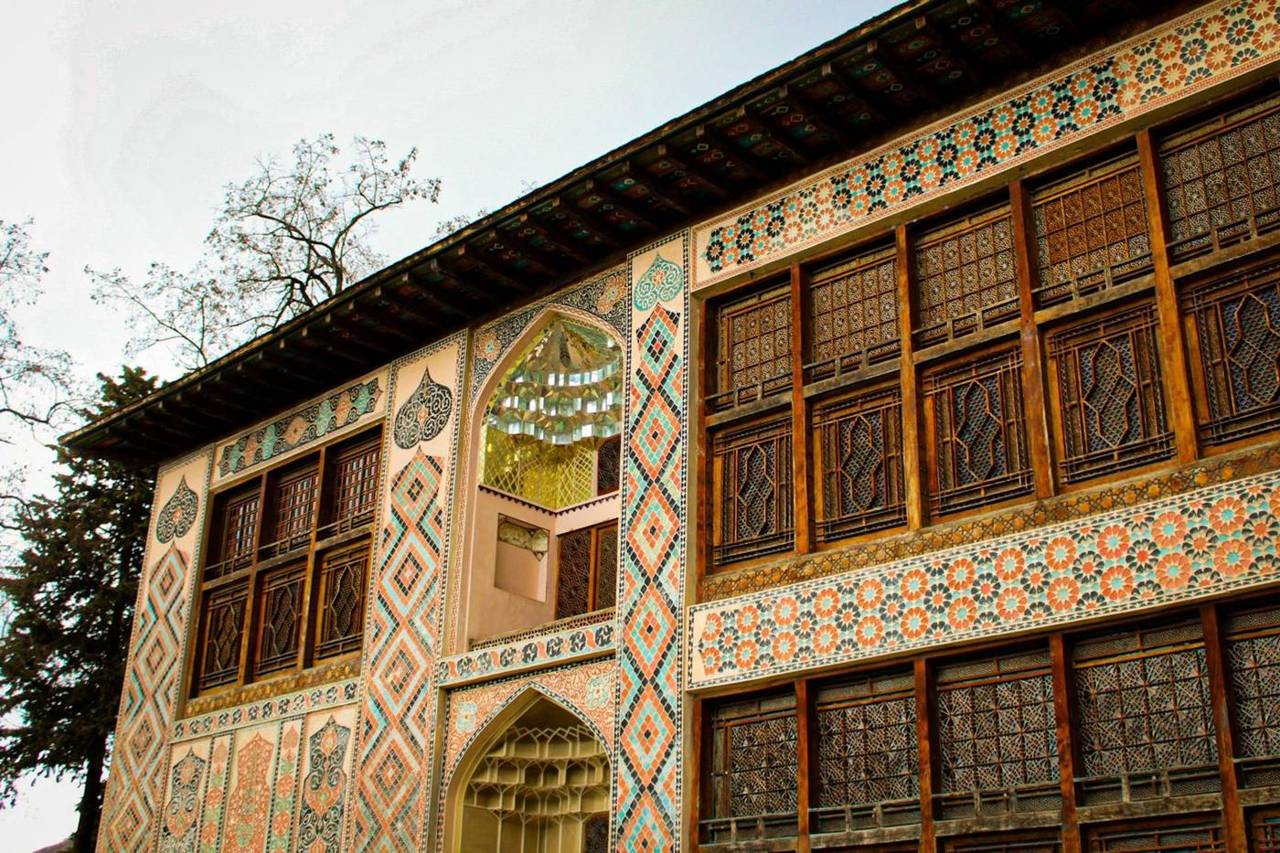
Visit the Palace of the Sheki Khans, from the eighteenth century, famous for its shebeke windows, coloured glass set in a wooden lattice without nails or glue, and for its walls painted with flowers, birds and hunting scenes. Check prices and times.
Then see the great caravanserai, where Silk Road merchants once stopped, with its courtyard and arcades on two floors.
In the evening have piti, a mutton and chickpea soup cooked in small clay pots, and try Sheki halva.
Sleep in Sheki.
Practical tip: in the Khan's Palace photos inside may be forbidden: ask before taking pictures.
- Day 5
Into Georgia, Bodbe convent and Signagi
Today you cross from Azerbaijan into Georgia.
If the land crossing is open, in the morning your driver takes you to the border between Balakan and Lagodekhi. Checks can be long: have your passport, visa and insurance ready. If the crossing is closed, go back to Baku and take a flight to Tbilisi, then drive to Kakheti: check before you leave which option is possible and plan your trip accordingly.
In Georgia you enter Kakheti, the wine region, with vineyards, orchards and the Greater Caucasus range to the north.
In the afternoon visit Bodbe convent, among cypresses and gardens above the Alazani valley, where according to tradition Saint Nino is buried, who brought Christianity to Georgia in the fourth century. Go in modestly dressed: women cover their hair and wear a skirt, often available at the entrance.
Then go to Signagi, a small town on a hill, with eighteenth-century walls and towers, houses with wooden balconies and views over the valley. Walk on the walls at sunset.
In the evening have Georgian dishes for dinner: khachapuri, cheese-filled bread, khinkali, large dumplings with broth and meat, and a glass of Kakheti wine made in qvevri, clay jars.
Sleep in Signagi.
Practical tip: in Georgia change money: lari are used, and cash machines are common in towns.
- Day 6
The cave monasteries of David Gareja and Tbilisi
Today you visit one of the most spectacular places in Georgia and reach the capital.
In the morning drive south, across a dry, almost empty steppe, very different from the green of Kakheti. After a long road, partly unpaved, you reach the David Gareja complex, founded in the sixth century by David, one of the Syrian fathers who came to Georgia to spread monastic life.
Visit the Lavra monastery, still inhabited by monks, with cells and churches cut into the rock. Then, if the path is open, climb the ridge towards the Udabno monastery, with its frescoed caves and views over the steppe. The ridge follows the border with Azerbaijan: always stay on the marked path and follow the instructions of your guide and the guards.
Bring water and a hat: in summer it is very hot and there is no shade. Also watch out for vipers among the rocks, especially in spring.
In the afternoon you reach Tbilisi, the capital, in the valley of the Mtkvari river, with houses with wooden balconies, churches and hills around it.
In the evening take a first walk in the old town and have dinner with Georgian dishes such as badrijani, aubergines with walnut paste.
Sleep in Tbilisi, for two nights.
Practical tip: wear light walking boots: the Udabno path is steep and stony.
- Day 7
Tbilisi: the old town, Narikala and the sulphur baths
Today you have the whole day for Tbilisi.
In the morning walk through the old town, among narrow streets, houses with carved wooden balconies and courtyards with vines. Visit Sioni cathedral and the church of Anchiskhati, one of the oldest in the city, from the sixth century.
Then climb to Narikala fortress, on foot or by cable car from Rike park. From the walls you see the whole city, the river, the domes and the statue of Mother Georgia, with a sword in one hand and a cup of wine in the other: the sword for enemies and the wine for friends.
At midday go down to the botanical garden, in the gorge below the fortress, with a small waterfall.
In the afternoon visit the Georgian National Museum, with the gold of the ancient kingdoms of Colchis and the remains of the first humans found at Dmanisi, among the oldest outside Africa. Check prices and times.
Towards evening go to Abanotubani, the sulphur baths district, with brick domes rising out of the ground. Take a hot bath in the sulphur water, in a shared or private room. Check prices and times.
In the evening enjoy Georgian polyphonic singing, if you find a concert.
Sleep in Tbilisi.
Practical tip: book a private room at the baths in advance, especially in the evening and at weekends.
- Day 8
Mtskheta, Kazbegi and Gergeti church
Today you climb into the heart of the Greater Caucasus.
In the morning drive north and stop at Mtskheta, the ancient capital of Georgia, a UNESCO World Heritage Site. Visit Svetitskhoveli cathedral, where according to tradition the robe of Christ is kept, and climb to the sixth-century Jvari monastery, on the hill above the meeting of two rivers.
Then take the Georgian Military Road, the historic route across the Caucasus towards Russia. You pass the Zhinvali reservoir and the fortress of Ananuri, with its churches and towers above the water, then climb through pastures and villages to the Jvari pass, at over 2,300 metres.
In the afternoon you reach Stepantsminda, also called Kazbegi. Above the village, on a green hill, stands the fourteenth-century Gergeti Trinity Church, with the snowy summit of Mount Kazbek, over 5,000 metres, behind it. Walk up in about an hour and a half or take a local four-wheel drive.
In the evening have a hot dinner in the village, with bean soup and bread, and watch the peaks turn colour at sunset.
Sleep in Stepantsminda.
Practical tip: the pass road can close for snow or landslides: check conditions before leaving and do not drive after dark.
- Day 9
Uplistsikhe and south to Vardzia
Today you cross Georgia from north to south among rock-cut towns.
In the morning drive down from Kazbegi towards the plain. Around midday you reach Uplistsikhe, near Gori, one of the oldest towns in Georgia, carved into the rock above the Mtkvari river. Walk among the caves, halls, theatres and passages cut into the stone, inhabited from the Iron Age to the Middle Ages. Check prices and times.
Then continue south-west through the Borjomi valley, with its forests and mineral waters famous throughout the Caucasus, and reach the Samtskhe-Javakheti region.
In the afternoon you reach Vardzia, the most famous cave monastery in Georgia, carved in the twelfth century into the face of Mount Erusheti at the wish of Queen Tamar. Hundreds of caves on several levels housed churches, cells, wine cellars, pharmacies and libraries. Visit the Church of the Dormition, with frescoes of the queen, and walk along the passages and stairs in the rock. Check prices and times.
At sunset the rock face turns golden above the river valley.
In the evening have dinner near Vardzia with river fish and local wine.
Sleep near Vardzia.
Practical tip: today's drive is very long: leave early and keep stops short, so you reach Vardzia in daylight.
- Day 10
Gelati and the Prometheus caves
Today you head west, into the Imereti region.
In the morning, if you like, also visit the Rabati fortress at Akhaltsikhe, with its restored walls, mosque and castle. Check prices and times. Then the road climbs and drops through hills and gorges towards Kutaisi, Georgia's second historic city.
In the afternoon visit Gelati monastery, founded in 1106 by King David the Builder, a UNESCO World Heritage Site. It was a great medieval academy, with scientists and philosophers. Inside the main church you see golden mosaics and frescoes of Georgian kings, and at the entrance lies the tomb of David the Builder.
Then go to the Prometheus caves, a karst cave with huge halls, stalactites, stalagmites and an underground river. It is visited along a lit route, and at some times of year there is also a stretch by boat. Check prices and times.
In the evening, in Kutaisi, walk in the centre, near the Colchis fountain, with golden statues inspired by the region's ancient jewellery, and have dinner with dishes from Imereti, such as Imeretian khachapuri and pkhali, vegetables with walnuts.
Sleep in the Kutaisi area.
Practical tip: inside the cave it is cool all year round: bring a sweatshirt even in summer.
- Day 11
Up to Svaneti and Mestia
Today you climb into Svaneti, one of the most beautiful mountain regions in the Caucasus.
In the morning drive north-west, through Zugdidi, and then up the valley of the Enguri river. The road runs beside the large reservoir of the Enguri dam, with turquoise water among the mountains, then enters deep gorges and forests. It takes several hours.
In the afternoon you reach Mestia, the main town of Svaneti, at about 1,500 metres, below the snowy peaks of the Caucasus. The village is famous for its medieval stone towers, which each family built to defend itself from attacks and feuds.
Visit the Svaneti Museum of History and Ethnography, which keeps icons, gold and silver crosses and medieval manuscripts, hidden for centuries in the churches of the valleys. Check prices and times.
Then go into one of the traditional houses with a tower, open as small museums, and see the common room where family and animals lived together in winter.
In the evening have Svan dishes: kubdari, bread filled with spiced meat, and Svan salt, with garlic and herbs.
Sleep in Mestia, for two nights.
Practical tip: bring warm clothes and a waterproof jacket: in the mountains the weather changes quickly even in summer.
- Day 12
A day in Ushguli
Today you reach Ushguli, the village at the end of Svaneti.
In the morning set off by four-wheel drive from Mestia. The road climbs for a few hours up the Enguri valley, among forests, pastures and small villages with towers. In places it is unpaved and narrow.
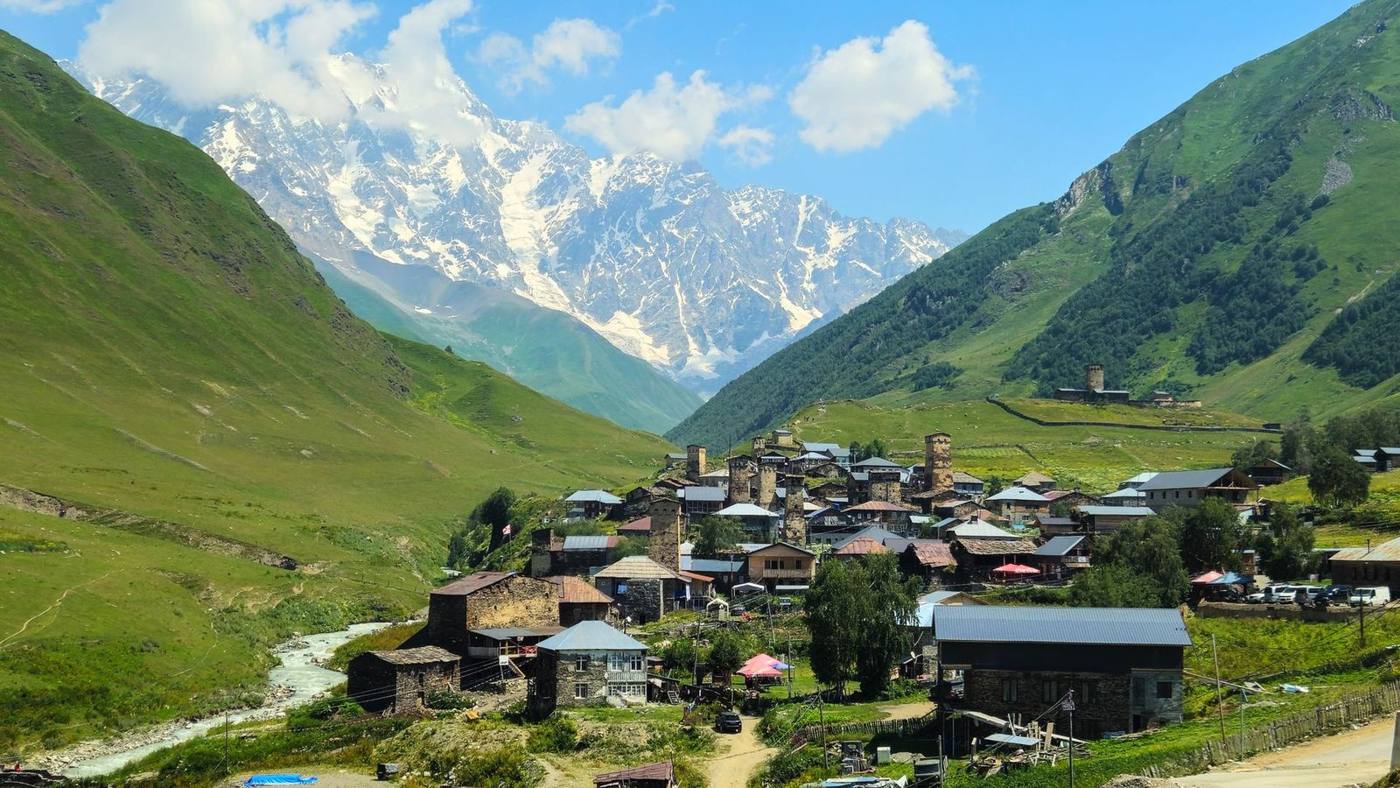
You reach Ushguli, a group of four villages at about 2,100 metres, among the highest inhabited in Europe. The stone towers, houses and medieval churches are a UNESCO World Heritage Site, together with all of Upper Svaneti. Behind the villages rises Shkhara, the highest mountain in Georgia, over 5,000 metres, with its glaciers.
Walk among the houses and climb to the church of Lamaria, on a hill above the village, with views of the towers and Shkhara. If you have time, take a walk of a few hours along the river towards the glacier.
At lunch eat in a village house, with warm bread, cheese and soup.
In the afternoon return to Mestia. If there is still light, climb to the viewpoint above the village to watch the sunset on the peaks.
Sleep in Mestia.
Practical tip: out of season the road to Ushguli can be closed by snow or mud: ask your guide about conditions before leaving.
- Day 13
Down to the Black Sea, Batumi and Gonio fortress
Today you come down from the mountains to the Black Sea.
In the morning you leave Mestia and go back down the Enguri valley to Zugdidi, then continue south across the Colchis plain, with fields of maize, tea plantations and citrus groves.
In the early afternoon you reach Batumi, the city on the Black Sea, with a seafront several kilometres long, modern tower blocks, palms and an old town of colourful houses.
Before entering the city, or just after, visit Gonio fortress, south of Batumi, near the border with Turkey. Roman and Byzantine walls enclose a large green space with the remains of baths and camps. Tradition says the apostle Matthias is buried here, and a small museum shows the finds from the excavations. Check prices and times.
In the late afternoon walk along the Batumi seafront to the statue of Ali and Nino, two large metal figures that move and meet, inspired by a love story between an Azerbaijani man and a Georgian woman: a perfect symbol for this trip.
In the evening have Adjarian khachapuri, boat-shaped, with cheese, butter and an egg in the middle.
Sleep in Batumi.
Practical tip: the Black Sea is warmest from July to September: in spring and autumn the water is cool.
- Day 14
The flight home
On the last day you leave the Caucasus.
In the morning, if your flight time allows, visit the Batumi botanical garden, on the hills north of the city, with plants from many continents and views over the sea. Check prices and times. Or take a last walk along the seafront and to the market, to buy spices, churchkhela, walnuts coated in grape juice, and wine.
Then go to Batumi airport, a few kilometres from the centre, or travel to Kutaisi or Tbilisi for your flight home.
In fourteen days you have seen Baku with its old city and contemporary architecture, Gobustan, the mud volcanoes and the fires of Absheron, Shamakhi and Sheki, Bodbe convent and Signagi, David Gareja, Tbilisi, Mtskheta and Kazbegi, Uplistsikhe and Vardzia, Gelati and the Prometheus caves, Svaneti with Mestia and Ushguli, and Batumi on the Black Sea.
In two weeks Georgia is seen in a rush, with many long transfers: if you can, add a few days.
When to go: May and June or September and October. In summer the lowlands are hot and the mountains are pleasant; in winter mountain roads and passes can close for snow.
Practical tip: take wine home in bottles well wrapped in your hold luggage and check the airline's rules.
For travellers who want to understand the Caucasus through the contrast between a Muslim oil state and a Christian mountain country. The highlight is the run of Baku, Sheki and David Gareja, which almost meet at the border. The drawback is that in two weeks Georgia is seen at speed, with many long transfers. The AnM programme is described by stages rather than day by day, so the schedule here is indicative.
Before you go
- Documents and visa
- Passport valid for the whole stay. British citizens can visit without a visa for up to one year. Since 1 January 2026 health and accident insurance is compulsory, valid for the whole stay, with cover of at least 30,000 lari: you may be asked for proof on arrival. Some British citizens have been refused entry or had trouble leaving, apparently linked to taking part in demonstrations or to unpaid fines.
- Health and vaccines
- No compulsory vaccinations. Medical facilities in remote areas are limited: you need insurance covering medical costs and repatriation. Georgia has strict rules on medicines: some products sold over the counter in the UK, such as those containing codeine, are illegal. Carry prescription medicines with the prescription and original packaging. Emergencies: 112.
- Money and payments
- Georgian lari. Withdrawing cash and changing euros or dollars is easy in Tbilisi and the main towns; carry cash in mountain villages.
- Power sockets
- Types C and F, 230 volts: you need an adapter for British plugs.
- Time zone
- UTC+4 all year, four hours ahead of the UK in winter, three in summer.
- Safety
- The UK advises against all travel to the Russian occupied regions of Abkhazia and South Ossetia, and against all but essential travel to the areas immediately next to the administrative boundary lines, which are generally unmarked. Protests have taken place in Tbilisi almost every day for nearly two years, centred on Parliament on Rustaveli Avenue, and some have turned violent: avoid demonstrations and large gatherings. At the Udabno caves of David Gareja, take care not to cross the unmarked border with Azerbaijan; the land border with Azerbaijan is closed. Mountain rescue can be limited. Official advice: GOV.UK.
Information checked in November 2026 for Italian and EU citizens. Rules change: always check before you travel.
Variations
In ten days you skip Svaneti and go from Kutaisi straight to Batumi, with fewer hours on the road.
In eighteen days you add a night in Quba and Xinaliq in Azerbaijan, an extra day in Tbilisi and a two-day walk in Svaneti.
Frequently asked questions
Can you cross overland from Azerbaijan to Georgia?
The land crossing may be closed. Check before you leave and, if necessary, take a flight between Baku and Tbilisi, then continue your trip by car.
Do you need a visa?
For Azerbaijan yes: the e-visa is applied for only on the official website evisa.gov.az. For Georgia Italian citizens do not need a visa, but health insurance is required.
Is it better to drive yourself or use a driver?
Use a local driver, especially in the mountains and in Svaneti, where roads are narrow and slow. In the cities taxis booked through apps work well.
Indicative itinerary written by World Atlas. Before booking, check timetables, seasonal openings, documents and safety.
 16 daysModerate
The whole Caucasus: Azerbaijan, Georgia and Armenia
Three countries in sixteen days, from Baku to Yerevan by way of Kazbegi, Svaneti and Vardzia, ending with Lake Sevan and Armenia's monasteries.
 10 daysChallenging
Trekking Upper Svaneti, from Mestia to Ushguli
Ten days on foot among medieval towers, passes above 2,700 metres and the glaciers of the Greater Caucasus, flying in and out of Kutaisi.
 10 daysChallenging
Across Tusheti and Khevsureti
From Omalo to Stepantsminda on foot, over the Atsunta and Chaukhi passes, with two nights under canvas in the most isolated valleys of the Georgian Caucasus.