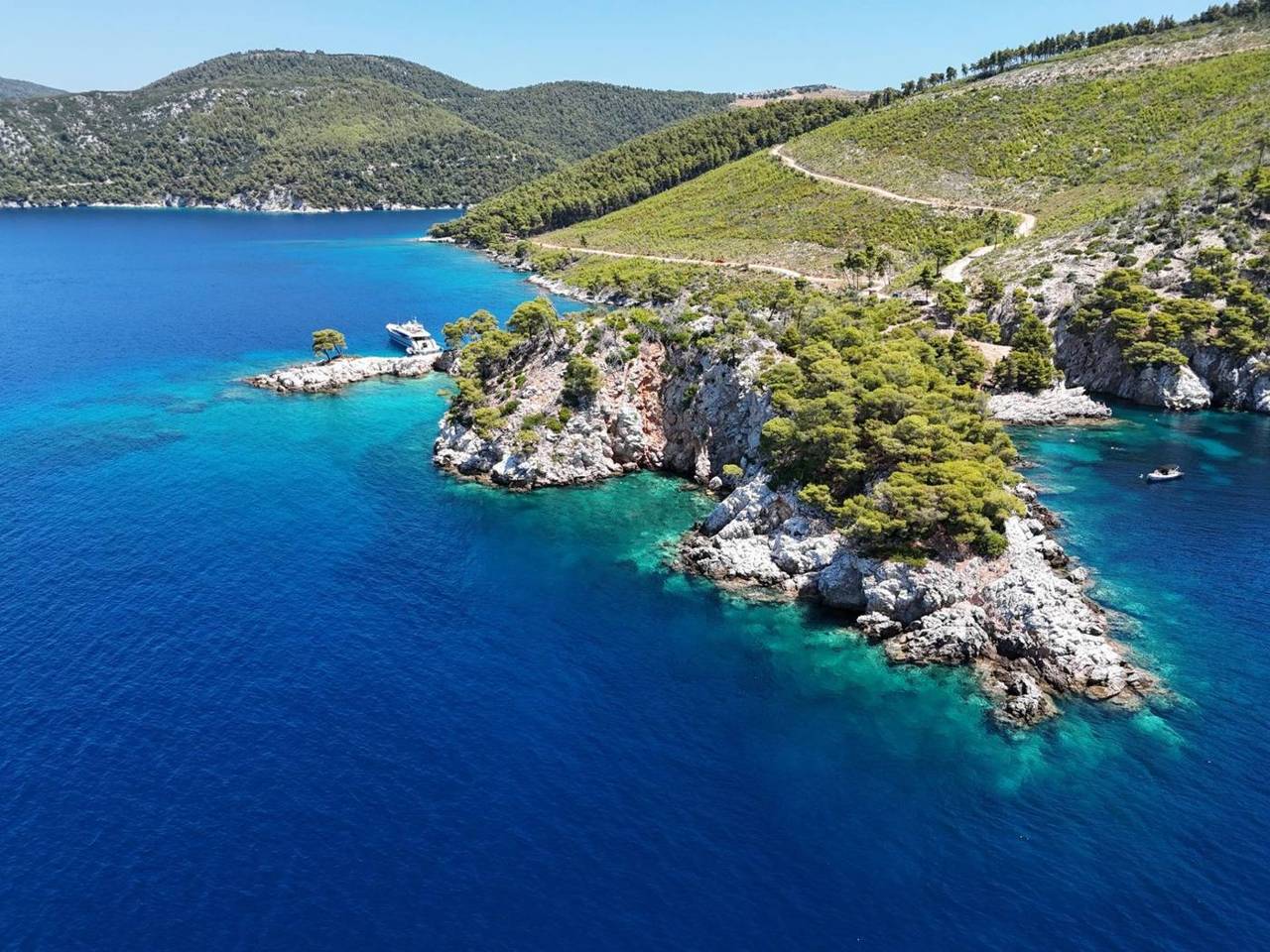
The Sporades: Alonissos, Skiathos and Skopelos
Three green islands in the western Aegean, with pine woods running down to the water, a marine park and a few trails up to the monasteries.
- Athens
- Volos
- Alonissos
- Skiathos
- Skopelos
Day by day
- Day 1
From Athens to Alonissos
This trip takes you to the Northern Sporades, three green Aegean islands covered in pines that reach down to the sea: Alonissos, the quietest, with a large marine park where the monk seal lives; Skiathos, with sandy beaches behind pine woods; Skopelos, with a white Chora on its harbour, monasteries and coves. They are less arid than the Cyclades, with clear water and forest trails.
Before you leave: EU citizens only need a valid electronic identity card or passport; other nationalities should check their own rules. In Greece accommodation charges a nightly tax that varies with category and season: check the amount when you book.
You fly into Athens. From the airport a bus or minibus takes you to Volos, on the Thessaly coast, in about four hours. In summer there are also direct flights from Europe to Skiathos: in that case it is better to do the route in reverse.
Ferries and hydrofoils leave Volos for the Sporades. The trip to Alonissos takes three or four hours, stopping at Skiathos and Skopelos. Check timetables, which change with the season, and book ahead in summer.
In the evening you arrive at Patitiri, the port of Alonissos, a quiet village with cafés on the waterfront.
Sleep on Alonissos.
Practical tip: the best time is late May to late June and September. In August the islands are full and ferries sell out.
- Day 2
Alonissos: the Chora and the port
In the morning go up to the Chora, the old village of Alonissos, on a hill above Patitiri, about fifteen minutes by bus or taxi, or an hour on foot along an old stone path among olive trees. The village was abandoned after an earthquake in 1965 and the inhabitants moved to the port. In the following years many houses were restored, and today the Chora is a maze of stone lanes, arches, flowered terraces and small churches, with sea views on both sides of the island.
Wander the lanes and stop on a terrace for coffee, looking at the islands of the marine park on the horizon.
In the afternoon go down to Patitiri and visit the small information centre on the Mediterranean monk seal, one of the rarest seals in the world, which lives in the marine park's caves. The centre explains the seals' life and the work to protect them. Check opening hours.
Also visit the Alonissos museum above the port, with objects from traditional life, fishing and the island's history, including pirates. Check opening hours and prices.
At sunset return to the Chora to watch the sun set into the sea from the highest terrace in the village.
Sleep on Alonissos.
Practical tip: public transport on Alonissos is limited. For the beaches it is best to rent a scooter or a small car.
- Day 3
The coves of Alonissos
Today you explore the beaches of Alonissos, nearly all small bays of white pebbles and clear water surrounded by pine forest, on the east coast, more sheltered from the wind.
The first stop could be Kokkinokastro, a bay with red cliffs, from which it takes its name, where the ancient city of Ikos once stood, now partly submerged. Then Leftos Gialos, a beach of white pebbles with turquoise water and shady trees.
Further north the road reaches Agios Dimitrios, a long tongue of white pebbles running into the sea, with blue water on both sides, one of the island's most beautiful beaches. Some beaches can only be reached by a dirt road or on foot, by a short path through the woods.
Alonissos also has a network of marked trails through pine woods, olive groves and old farms down to the sea: ask for the map at the information office.
For lunch eat at a beach taverna if there is one, or bring a picnic: some bays have no facilities.
In the late afternoon return to Patitiri.
In the evening have dinner at the port with the catch of the day and Alonissos tiropita, a fried spiral cheese pie.
Sleep on Alonissos.
Practical tip: bring water, food and a sunshade to beaches without facilities. In the shade of the pines it is cool even in August.
- Day 4
The marine park and Peristera
Today take a boat trip into the National Marine Park of Alonissos and the Northern Sporades, Greece's largest marine protected area, created in 1992 to protect the Mediterranean monk seal. It includes Alonissos and several uninhabited islands around it, such as Peristera, Kyra Panagia, Gioura and Piperi, where access is banned or strictly limited.
Boats leave Patitiri in the morning for a day trip, usually to Peristera, the large island opposite Alonissos, and Kyra Panagia, with a monastery overlooking a bay. There are swimming stops in coves of crystal clear water. With a little luck you see dolphins and, very rarely, a monk seal: it is a shy animal, and you must not approach or follow it. Check times and prices.
Near Peristera, on the seabed, lies the wreck of a Greek merchant ship from the fifth century BC, loaded with thousands of wine amphorae, one of the most important ancient wrecks in the Mediterranean. Today it is an underwater museum, visited only on organised, authorised dives, at set periods. Check the current rules.
In the evening return to the port.
Sleep on Alonissos.
Practical tip: in the marine park no fishing and no litter. Choose boats that respect the rules and keep their distance from wildlife.
- Day 5
To Skiathos and Koukounaries beach
In the morning take the ferry or hydrofoil from Alonissos to Skiathos, about an hour and a half, via Skopelos. Skiathos is the liveliest of the Sporades, with a small international airport and more than sixty beaches, nearly all sandy.
Drop your bags and take the bus along the south coast, with numbered stops for each beach, to the end of the line, Koukounaries, the island's most famous beach. It is a long crescent of fine golden sand, with shallow clear water, backed by a pine wood that reaches the sand. Behind the wood is a lagoon, a protected area with waterbirds.
If you want fewer people, walk to the nearby beaches such as Banana and Krassa, reached by a short path over the hill.
In the late afternoon return to town. Skiathos town is built on two hills around the harbour, with white houses, red roofs, stepped lanes and a small peninsula, the Bourtzi, with a pine wood and a café by the sea.
In the evening have dinner at the old harbour, watching planes land very low over the sea near the runway.
Sleep on Skiathos.
Practical tip: Koukounaries is crowded in summer. Go early in the morning or late in the afternoon.
- Day 6
Lalaria and the blue caves by boat
Today take a boat trip around the island from Skiathos old harbour. It is the best way to see the north coast, steep and wild, reachable almost only by sea.
The first stop is Lalaria, a beach of smooth white pebbles below grey limestone cliffs, with a great natural rock arch in the sea. The water is an intense blue. Taking pebbles away is forbidden.
Then the boat enters the nearby sea caves, known as the blue caves, such as Skotini, a dark cave the boat enters through a narrow crack, and Galazia, where light coming in underwater turns everything blue.
Many trips also stop below the Kastro, the old fortified village on the north coast, and in a cove for a swim. Check boat times and prices.
In the afternoon land near the Kastro or reach it on a path. Here islanders took refuge in the sixteenth century from pirates, on a rocky promontory linked to the island by a drawbridge. Today the ruins of houses and a few small churches with frescoes remain, with a spectacular sea view.
In the evening return to town.
Sleep on Skiathos.
Practical tip: the north coast trip depends on the wind. With a strong meltemi boats do not leave or change route.
- Day 7
Skiathos: Papadiamantis and the trails
In the morning visit the house of Alexandros Papadiamantis, one of the greatest Greek writers, born on Skiathos in 1851, whose stories told of the lives of island fishermen, farmers and priests. His house in the centre of town is a small museum with the writer's furniture, books and belongings. Check opening hours and prices. There is also a statue of him at the harbour.
Then, if you like walking, follow one of the island's marked trails through pine and strawberry tree woods, olive groves and valleys. One path climbs to Evangelistria monastery, from the eighteenth century, hidden in the woods north of town, where in 1807 one of the first Greek flags of the war of independence was sewn and blessed. The monastery has a small museum and a winery. Check opening hours.
In the afternoon swim at a south coast beach such as Agia Eleni or Mandraki, reached on foot from the road, with sand dunes and pines.
At sunset go to the point of Agia Eleni, on the west coast, from where you watch the sun set behind Mount Pelion on the mainland.
Sleep on Skiathos.
Practical tip: when entering monasteries cover shoulders and knees. Shawls and skirts are sometimes lent at the entrance.
- Day 8
Skopelos: the Chora and the beaches
In the morning take the ferry or hydrofoil from Skiathos to Skopelos, about an hour, to the port of the Chora.
The Chora of Skopelos is one of the most beautiful villages in the Sporades: an amphitheatre of white houses with grey slate roofs and wooden balconies, climbing from the harbour up a hill, with more than a hundred churches and chapels. At the top are the remains of a Venetian fortress, with a view over the whole harbour. Walk the steep lanes, among stairways, geraniums and cats.
In the afternoon rent a car or scooter, or take the bus along the south west coast, with the island's finest beaches. Panormos is a sheltered bay with pebbles and pines; Milia is a long beach of white pebbles with turquoise water and a view of Skiathos; Kastani is a small sandy bay with pines down to the sea; Hovolo, near Neo Klima, has white cliffs and coves.
In the evening return to the Chora and have dinner with island food, such as spiral cheese pie and dishes with plums, grown on Skopelos for centuries.
Sleep on Skopelos.
Practical tip: the main road on Skopelos is narrow and winding. Drive slowly, especially on a scooter.
- Day 9
The monasteries and Agios Ioannis
Today you explore the interior of Skopelos, a green island of pines, olives and plum trees, with many monasteries.
In the morning climb Mount Palouki, east of the Chora, where there are several monasteries, some still inhabited by nuns, such as Evangelismos, from the eighteenth century, clinging to the mountainside with a view over the Chora and the sea. You can drive or walk up an old stone path from town. Check opening hours: the monasteries close at midday.
In the afternoon go to the north east coast, to Agios Ioannis sto Kastri, a small white chapel on a high rock above the sea, reached by a stairway of more than a hundred steps cut into the rock. It became famous worldwide after a musical film was partly shot here. Climb slowly, it is tiring in the heat. From the top the view of the blue sea is splendid.
In the evening return to the Chora for your last dinner in the Sporades, perhaps in a taverna overlooking the harbour.
Sleep on Skopelos.
Practical tip: enter monasteries quietly and in covered clothing. A small offering for upkeep is welcome. At Agios Ioannis bring water and shoes with a good grip: the rock steps are smooth and there is no shade in the hot hours.
- Day 10
Back to Volos and Athens
On the last day take the ferry or hydrofoil from Skopelos to Volos, about three hours. Check the timetable and get to the port early: in summer the boats are full.
In Volos, if you have some time, walk along the seafront among cafés and tsipouro taverns, serving the grape spirit with small plates of fish and vegetables, typical of the town. Volos is also the gateway to Mount Pelion, with stone villages in the forest, if you have more days.
Then take the bus or minibus to Athens airport, about four hours, or the train to Athens from Volos with a change at Larissa. Plan your timing carefully: for an evening flight it is best to leave Volos around lunchtime.
Arrive at the airport early.
Before leaving buy something to take home: dried plums and plum jam from Skopelos, pine honey, olive oil, dried oregano or a small ceramic piece.
This trip shows a green and quiet Greece: islands with pine woods down to the sea, sandy and white pebble beaches, stone villages, monasteries on cliffs and a protected sea where one of the world's rarest seals lives.
Practical tip: if you can, take a direct flight to Skiathos on the way out or back. You save the long transfer from Athens.
For those who want sea and greenery without the harsh light and crowds of the Cyclades. Alonissos is the quietest and the finest seen from a boat. Skiathos is crowded and loud in summer, which is why May or September work best; the order of the islands depends on ferry timetables.
Before you go
- Documents and visa
- EU citizens need a valid identity card or passport, including on ferries, where ID may be checked at boarding. Other nationalities should check the Schengen rules.
- Health and vaccines
- No vaccines required. EU citizens should bring their EHIC; in summer protect yourself from the sun and drink plenty. Emergencies: 112.
- Money and payments
- Euro. Cards are accepted almost everywhere; every accommodation charges a fee per room per night, often paid on departure.
- Power sockets
- Types C and F, 230 volts.
- Time zone
- Eastern European Time (UTC+2), summer time (UTC+3) from late March to late October.
- Safety
- A safe country. In summer watch for wildfires and 112 alerts; in Athens, for pickpockets on the metro. Official advice: GOV.UK.
Information checked in November 2026 for Italian and EU citizens. Rules change: always check before you travel.
Variations
In 7 days: only Skiathos and Skopelos, arriving and leaving from Skiathos airport.
In 13 days: add three days on Mount Pelion, with the villages of Makrinitsa and Tsagarada.
Frequently asked questions
What document do I need?
EU citizens only need a valid electronic identity card or passport. Other nationalities should check their own rules. Accommodation charges a nightly tax: check the amount when you book.
How do you get between the islands?
By ferry and hydrofoil from Volos and between the islands. Timetables change with the season and the wind: check them and book ahead in summer.
When is the best time to go?
Late May to late June and September. August is crowded; with a strong meltemi some boats do not sail.
Indicative itinerary written by World Atlas. Before booking, check timetables, seasonal openings, documents and safety.
 8 daysEasy
The Dodecanese by Gulet: Kos, Leros, Patmos and Kalymnos
A week aboard a wooden gulet sailing from Bodrum, among the smaller islands, roadless bays and the monastery of Patmos.
 9 daysEasy
Rhodes by Car: Lindos, Kameiros and the South
One island explored at an easy pace, from the city of the Knights to the inland villages, with a hire car as the base.
 10 daysEasy
Kefalonia and Ithaca, Odysseus's Sea
Ten days in the Ionian islands among cliffs, karst caves and Venetian villages, with a crossing to the island Homer gave to Odysseus.