From Petra to AlUla: Jordan and Saudi Arabia
Following the Nabataeans from one capital to the other: Petra in Jordan, then overland across the border to the tombs of Hegra and the canyons of AlUla.
- Amman
- Jerash
- Madaba
- Petra
- Wadi Rum
- Aqaba
- Tabuk
- AlUla
- Hegra
- Riad
Day by day
- Day 1
Arriving in Amman and the Citadel
This fifteen-day trip follows the Nabataeans from one capital to the other: Petra in Jordan, then across the border overland to the tombs of Hegra and the canyons of AlUla in Saudi Arabia, finishing in Riyadh. In Jordan you travel by hire car or with a driver; in Saudi Arabia with a driver, a hire car and a domestic flight.
Before you go: Italian citizens need a passport valid for at least six months from entry. For Jordan you need a visa, applied for online on the Jordanian Ministry of Interior website or on arrival at Queen Alia airport. The Jordan Pass, bought only on the official website jordanpass.jo before you leave, costs 70, 75 or 80 dinars for one, two or three consecutive days in Petra, includes Jerash, Wadi Rum and more than forty sites, and covers the visa fee if you stay at least two nights. For Saudi Arabia you need a tourist e-visa, applied for before leaving only on the official website visa.visitsaudi.com: it is valid for a year and includes basic health insurance. Other nationalities should check their own rules.
Some areas on this trip are close to borders or places where the situation changes often: check your government's travel advice before booking and again before you leave.
In the afternoon climb to the Amman Citadel, with the Temple of Hercules and the Umayyad palace, and look at the city from above.
Practical tip: buy the Jordan Pass with two days in Petra and keep printed copies of both visas.
- Day 2
Jerash and the Balad of Amman
Today you go to Jerash, about an hour north of Amman, a great Roman city of the Decapolis.
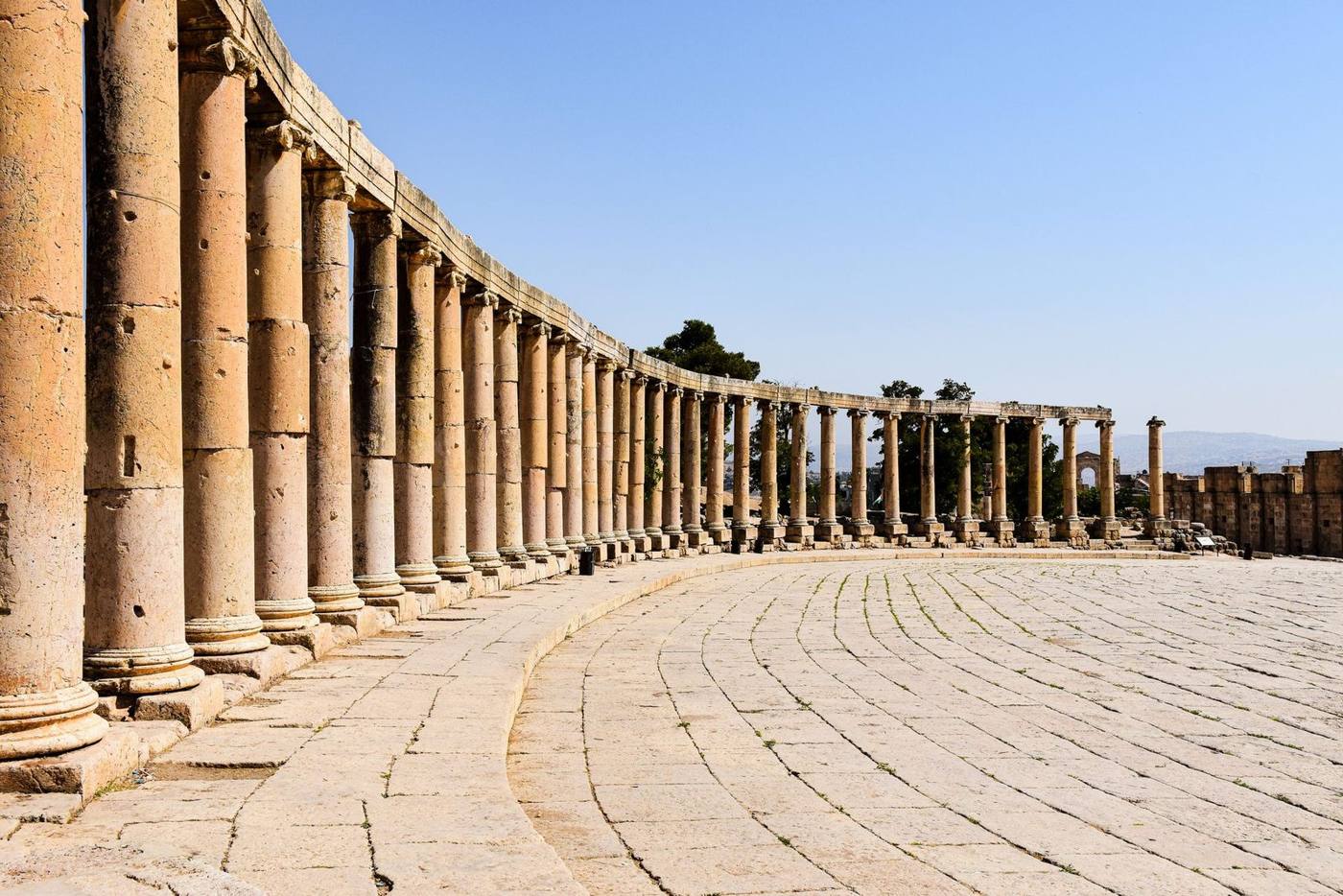
You enter through Hadrian's Arch and pass the hippodrome, then reach the Oval Plaza with its ring of columns. From here the cardo, the long colonnaded street, crosses the whole city, with original paving marked by chariots. Along the way you find the nymphaeum, the monumental fountain, and above on the hill the Temple of Artemis, with columns that sway very slightly when the wind blows.
The South Theatre has exceptional acoustics: try speaking from the centre of the stage and hear how your voice carries to the back row. The site is included in the Jordan Pass and you need at least three hours to see it, with little shade. At the entrance there is a small souvenir market.
In the afternoon return to Amman and go down to the Balad, the old centre. Visit the Roman theatre cut into the hillside, then walk among the souk's shops, with spices, dried fruit, fabrics and sweets.
In the evening try Jordanian dishes: hummus, falafel, herb salads, and mansaf, lamb cooked in dried yoghurt and served on a large tray of rice.
Practical tip: set off early for Jerash and bring a hat, because there is no shelter from the sun among the ruins.
- Day 3
Madaba, Mount Nebo and Kerak
Today you head south along the King's Highway, the ancient road across the plateau through villages, canyons and castles.
The first stop is Madaba. In the Church of St George look at the mosaic map of the Holy Land, from the sixth century, with Jerusalem at the centre and the Dead Sea with fishing boats. Then continue to Mount Nebo, where tradition says Moses saw the Promised Land: the basilica has mosaics with animals and hunting scenes, and from the terrace you see the Jordan Valley.
Back on the road, cross the canyon of Wadi Mujib, with a hairpin descent and a spectacular climb. Stop at the viewpoint.
In the early afternoon you reach Kerak, with its great Crusader castle built on a rocky spur. Walk through the vaulted galleries, the dark halls and along the walls, from where the view reaches the Dead Sea. Check prices and times.
Then continue south to Wadi Musa, the town next to Petra, where you sleep for two nights.
The King's Highway is slow and full of bends: leave early, drive calmly and try to arrive before dark, because at night speed bumps and animals on the road are hard to see.
Practical tip: bring a small torch to Kerak castle, because some galleries are very dark.
- Day 4
Petra, the Siq and the Nabataean facades
Today you enter Petra, the Nabataean capital carved into pink rock, a UNESCO World Heritage Site. Look at it carefully: in a few days you will see tombs of the same civilisation at Hegra.
Go in at opening time. After the first stretch down the valley you enter the Siq, a long, narrow gorge with towering walls. Along the way look at the channel cut into the rock that brought water to the city and the remains of a camel caravan carved into the wall. At the end the Treasury appears, the most famous facade.
Continue along the Street of Facades. Many tombs have a row of carved stepped crenellations at the top: it is the same motif you will see at Hegra, typical of Nabataean architecture. You reach the theatre, then climb to the Royal Tombs on the right-hand cliff, with the Urn Tomb and the Silk Tomb with its striped colours.
In the afternoon walk along the colonnaded street to the Great Temple and Qasr al-Bint.
If you want to save effort, choose the authorised carts on the first stretch, or walk: the animals offered are not always well treated.
In the evening, on the days it runs, you can come back for Petra by Night, with the Siq lit by candles. Check prices and times.
Practical tip: photograph the details of the facades, so you can compare them with those at Hegra.
- Day 5
Petra, the Monastery and the high places
Today you go back into Petra to climb to the highest points of the city.
Go in early and walk to the far end of the valley, beyond Qasr al-Bint. From here the Monastery staircase, Ad Deir, begins: around eight hundred steps cut into the rock, with bends and small stalls where you can drink tea. It takes about an hour.
At the top the facade of the Monastery appears, enormous, on a small plain among the mountains. Sit in front of it and watch the light change on the stone. Then climb to the nearby viewpoint, from where you see the mountains stretching to the Araba valley.
Come down slowly. If you still have energy, in the afternoon take the path up to the High Place of Sacrifice, an altar cut on a summit, with a wide view over the whole of Petra. The path is steep and has no barriers: only do it if you feel up to it and with plenty of water.
Alternatively, leave Petra and visit Little Petra, a few kilometres away, a canyon with facades and banqueting halls where caravans used to stop, much quieter.
In the evening, in Wadi Musa, try zarb, meat and vegetables cooked under the sand.
Practical tip: after two days in Petra your legs are tired: tomorrow in Wadi Rum you will be in a jeep most of the time, so this is the right moment to rest.
- Day 6
Wadi Rum and a night in camp
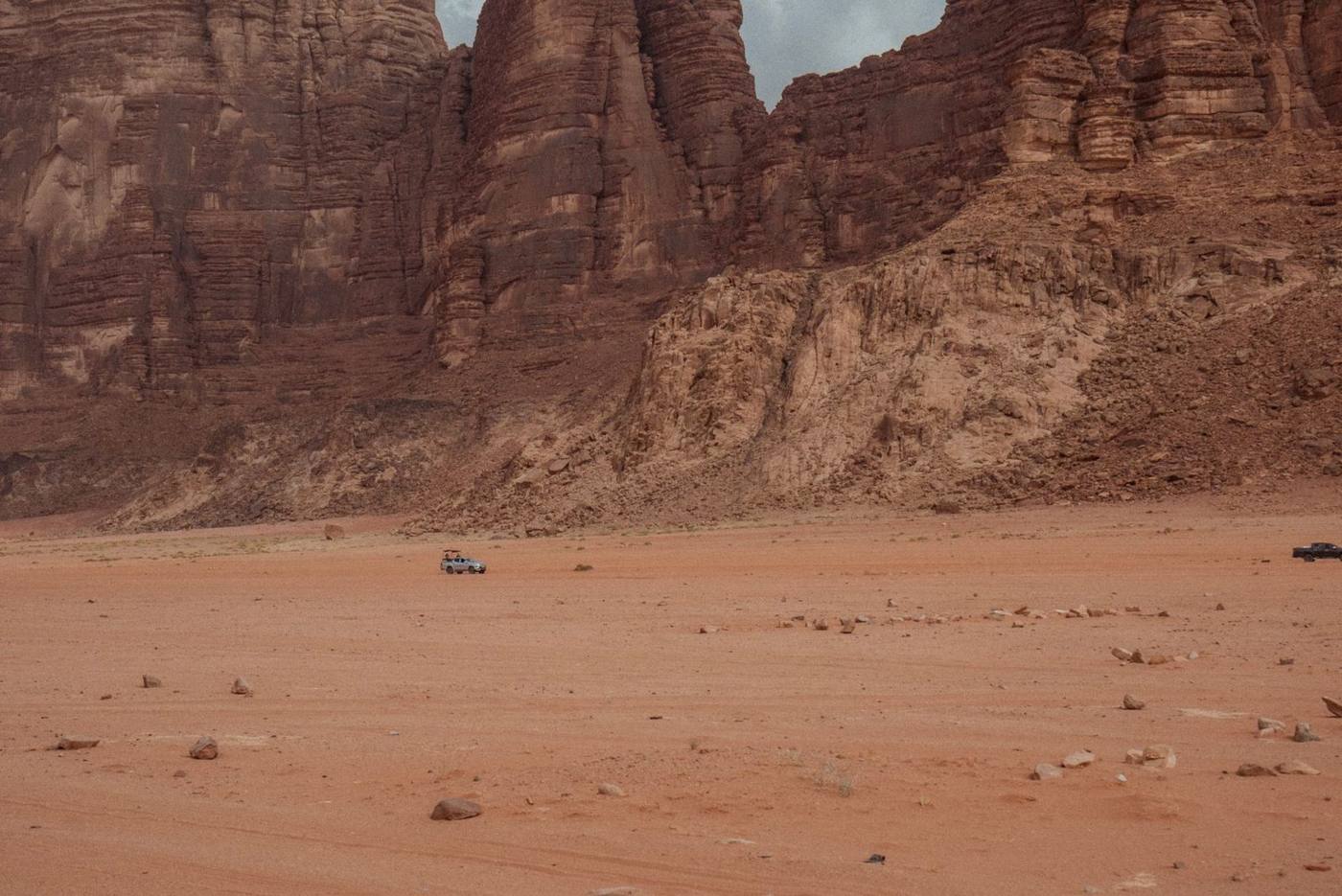
Today you head south to Wadi Rum, the valley of the moon, a desert of red sand and sandstone mountains that is a UNESCO World Heritage Site.
In about two hours you reach the visitor centre, included in the Jordan Pass. Here you leave the car and climb into a jeep driven by a Bedouin. The tour crosses the sand and stops at the finest places: Khazali canyon with its rock carvings, red dunes to climb, rock arches and the spring linked to Lawrence of Arabia. The Nabataean inscriptions you see here are relatives of those at AlUla.
At the stops the Bedouin make sage tea over the fire, sitting on carpets in the shade.
At sunset climb a rock to watch the sun go down between the mountains, then head to the tented camp. Dinner is cooked under the sand, and at night the sky is full of stars.
Do not wander away from the camp on foot alone and wrap up well: even in the warm months the nights are cold, and in winter the temperature can drop close to freezing.
If you enjoy walking, ask the guide for a short walk into a narrow canyon, where the jeep cannot go and you only hear the wind.
Practical tip: book a camp with the jeep transfer included, so you do not drive on sand.
- Day 7
Aqaba and the Red Sea
In the morning watch the sunrise over the desert, then leave Wadi Rum and drive down in under an hour to Aqaba, Jordan's only city on the sea.
Aqaba lies at the head of the gulf of the same name, with mountains behind and a calm sea in front. The Red Sea here has coral reefs close to shore: with a mask and snorkel, at the beaches on the south coast, you see corals, parrotfish and butterflyfish a few metres from the beach. If you are certified, you can dive with a dive centre. Do not touch the corals and wear a T-shirt against the sun.
In the afternoon visit Aqaba fort, a small Mamluk fortress near the seafront, linked to the history of the Arab Revolt. Then walk along the seafront and through the market in the centre, with fruit, spices and fish. In the evening the seafront comes alive with families, sellers of roasted corn and small tea stalls.
In the evening taste sayadieh, fish cooked with rice, onion and spices, the city's typical dish.
Today also prepare for tomorrow's crossing: check your documents, your printed visas and the meeting time with your driver. Jordanian hire cars usually cannot enter Saudi Arabia, so return yours here.
Practical tip: keep a few dinars in cash for any fees and expenses at the border.
- Day 8
The border and the road to Tabuk
Today you enter Saudi Arabia overland. The Al Durra crossing lies just south of Aqaba, on the coast.
Before setting off check that the crossing is open to foreign tourists and that your Saudi e-visa is valid for entry by land. The crossing takes time, with exit checks from Jordan, baggage checks and entry into Saudi Arabia. It is easier with a driver or a local agency who knows the procedures and waits for you on the other side. Do not carry alcohol, medicines without a prescription or any banned products.
After the border the road runs down the Gulf of Aqaba. On your left are the Hejaz mountains, on your right the blue sea, with the Egyptian coast of Sinai visible on the horizon on clear days. You pass the small town of Haql, then the road climbs inland.
In the afternoon you reach Tabuk, a city on the plateau. If you have energy, visit Tabuk castle, a restored fortress in the centre, and the old station of the Hejaz Railway, the line that linked Damascus to Medina in the early twentieth century. Check prices and times.
In Saudi Arabia always carry a copy of your passport and visa, and wear loose clothes covering elbows and knees.
Practical tip: leave Aqaba early, so you cross the border and drive only in daylight.
- Day 9
From Tabuk to AlUla through the sandstone desert
Today you cross the desert to AlUla. The journey takes several hours, and it is best done with a driver who knows the road.
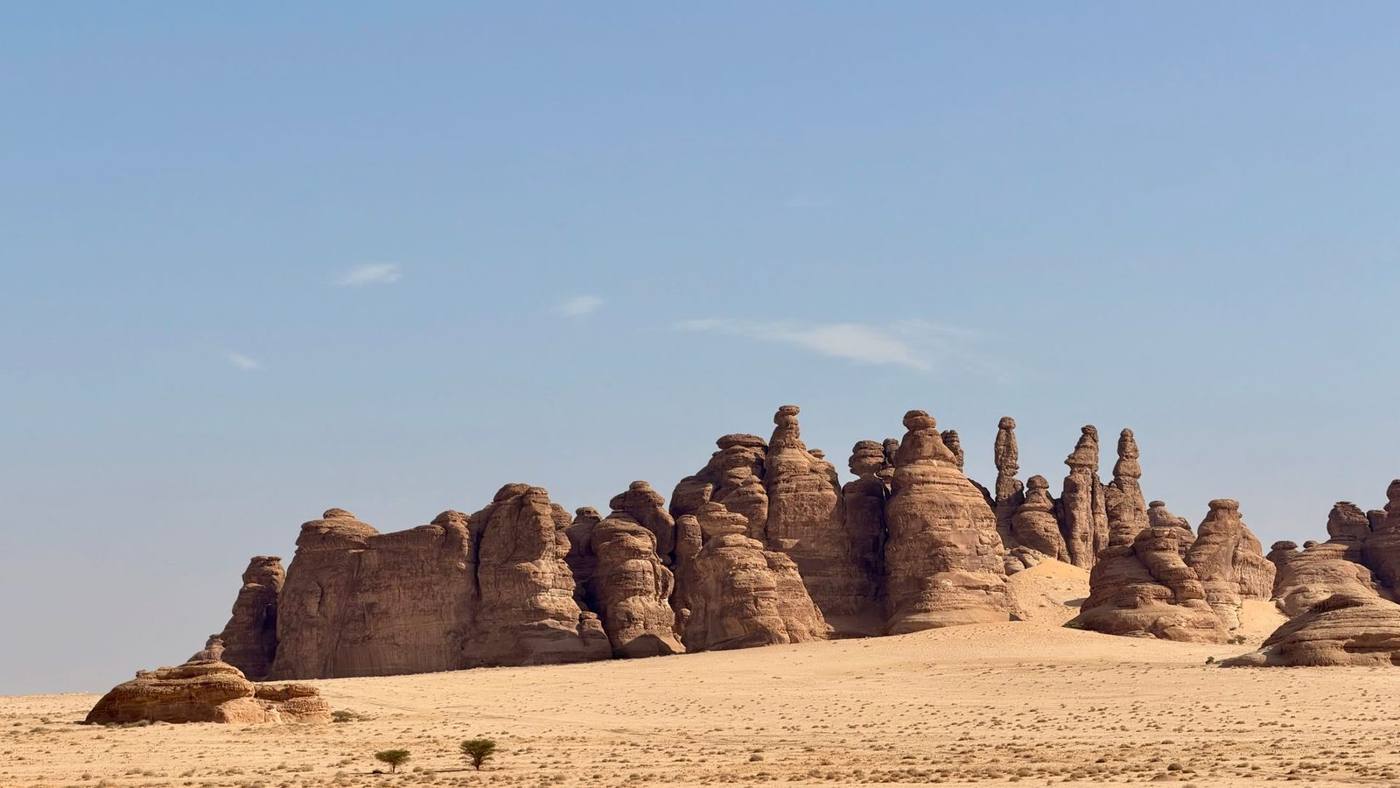
As soon as you leave Tabuk you enter a landscape that recalls Wadi Rum: sandstone towers, rock arches, plains of red sand and mountains shaped by the wind. It is the same geology you saw in Jordan, and you understand why Nabataean caravans followed this route, between wells and natural shelters.
Make a few stops to photograph the rock formations, but stay close to the car and do not leave the tarmac in an ordinary car. In the desert the distances between petrol stations are long: fill up and carry plenty of water.
In the afternoon you reach AlUla, a green valley of palms enclosed by sandstone walls. After dropping your bags, go to the old town, a maze of mud-brick and stone houses lived in for centuries. Walk through the lanes, climb to the castle on the hill and look at the palm grove at sunset.
Sleep in AlUla for four nights.
Along the road there are checkpoints: keep your passport and visa handy and answer questions calmly.
Practical tip: book the timed visits to Hegra and Dadan online, on the official AlUla website, because places are limited.
- Day 10
Hegra, the Nabataean city
Today you reach the heart of the trip: Hegra, the Nabataeans' second city after Petra, the first site in Saudi Arabia added to the UNESCO World Heritage list.
Hegra can only be visited on official timed tours booked online: you cannot drive in with your own car. The tour leaves from the point shown on your ticket, with a coach that takes you among the tombs, accompanied by a local storyteller, the rawi. There are also private visits by four-wheel drive with a driver.
The site has more than a hundred tombs carved into the rock. Here the thread of the trip becomes clear: the facades have the same stepped crenellations you saw at Petra, but they are carved into isolated rocks in the desert, and many carry inscriptions with the owners' names and dates. Above the doors you will see eagles, rosettes and masks.
The most famous tomb is that of Lihyan son of Kuza, called Qasr al-Farid, the lonely castle: it is cut into a single isolated boulder and its lower part is unfinished, so you can see how the sculptors worked from the top down.
You will also see the Diwan, a hall cut into the rock for ritual banquets, and a narrow gorge between the cliffs.
Stay on the paths and only look at the tombs from outside.
Practical tip: choose the early morning or late afternoon tour, with less heat and warmer light.
- Day 11
Dadan and the inscriptions of Jabal Ikmah
Today you go back in time, to the kingdoms that came before the Nabataeans in AlUla.
In the morning visit Dadan, the ancient capital of the kingdoms of Dadan and Lihyan, which controlled the incense caravans. In a red rock face are cut the Lion Tombs, funerary niches decorated with figures of lions. At the foot of the cliff archaeologists are still excavating the city, with temples and large stone basins. Visits are timed: check prices and times.
Then go to Jabal Ikmah, a canyon known as the open-air library. On the sandstone walls there are hundreds of inscriptions in ancient languages and early Arabic scripts, along with drawings of animals and human figures. They tell of offerings to the gods, laws and the names of travellers. With the guide look for the differences between the scripts: some are related to those you saw in Khazali canyon in Wadi Rum.
In the afternoon rest in the oasis. Many farmers open their orchards of palms and citrus: ask them to explain how dates are grown and taste the local honey.
In the evening have dinner in the old town with kabsa, spiced rice with meat, and Arabic coffee with cardamom.
Practical tip: bring small binoculars or use your phone's zoom, because many inscriptions are high up.
- Day 12
The old town and Elephant Rock
Today you explore AlUla's landscapes and end with the valley's most famous sunset.
In the morning go back to the old town in daylight, when the details of the mud houses are easier to see: palm-trunk beams, small windows, narrow stairs and covered passages that kept the heat away. Visit the small exhibitions along the restored main street and the craft workshops.
In the late morning take a trip into the Ashar valley, a sandstone canyon with towering walls, on foot along marked trails or by four-wheel drive with a driver. Along the road you will see Maraya, the mirror-clad building that reflects the desert; access inside depends on events, but it is worth a stop even from outside.
In the afternoon rest in the shade. Then, towards sunset, go to Elephant Rock, a large sandstone formation shaped like an elephant, with its trunk touching the sand. Around it there are low seats and small cafés. Watch the sky change colour and the rock become a dark silhouette.
Only drive by day between the valleys and do not leave the tarmac in an ordinary car.
In the evening, if one is scheduled, join a stargazing session in the desert, far from the valley lights.
Practical tip: in winter the desert evenings are cold: bring a jacket.
- Day 13
Flight to Riyadh and At-Turaif in Diriyah
Today you leave AlUla on a domestic flight to Riyadh, the capital, in the heart of the Najd.
On arrival drop your bags and rest during the hottest hours. Riyadh is a huge city with long distances: get around by app taxi or by metro.
In the late afternoon go to Diriyah, on the north-western edge, along the valley of Wadi Hanifa. In the eighteenth century the first Saudi state was born here. The At-Turaif district, a UNESCO World Heritage Site, is a mud-brick city built on a rise: thick sand-coloured walls, towers, triangular battlements and inner courtyards. Since its restoration it can be visited along a marked route, with small museums on daily life, architecture and the history of the dynasty. Salwa Palace is the heart of the site. Check prices and times.
Compare these mud houses with those of AlUla's old town: two different ways of building in the desert, one in the oases of the Hejaz, the other on the Najd plateau.
At sunset the walls are lit up and the district fills with families out for a stroll. Cross the bridge and have dinner in Bujairi, the district opposite, with terraces overlooking the ruins.
Practical tip: buy your At-Turaif ticket online, especially at weekends, when many families come.
- Day 14
The National Museum and Masmak fort
Today you discover the history of the Arabian Peninsula in Riyadh's museums and historic sites.
In the morning visit the National Museum, in the historic Murabba district. The galleries follow the story from prehistory to the ancient kingdoms, then to Islam and the birth of the kingdom. Look for the galleries on the kingdoms of ancient Arabia and the incense routes: you will find Dadan, Lihyan and the Nabataeans again, the thread of the whole trip. Check prices and times. Next to the museum is Murabba Palace, a mud-built royal residence with courtyards.
In the afternoon go to Masmak fort, a mud-brick fortress with round towers. In 1902 the young Abdulaziz Al Saud captured it with a handful of men, the first step towards today's Saudi Arabia. Look at the old door and the historic photographs. Check prices and times.
Next to the fort is Souq Al Zal, the city's oldest market, with carpets, daggers, frankincense and cloaks. It is the right place for last purchases.
In the evening, if you want to see modern Riyadh, go up to the sky bridge of the Kingdom Centre tower and watch the city lights.
Do not photograph royal palaces, government or military buildings, and always ask before photographing people.
Practical tip: pay any traffic fines before leaving, because they are linked to your passport.
- Day 15
Flying home from Riyadh
Today is your travel day home.
If your flight is in the afternoon, take a morning walk in the Wadi Hanifa park or go back to the souk to buy dates, Arabic coffee or frankincense. The airport is north of the city: with the traffic, leave in good time.
Trip summary: in fifteen days you have followed the Nabataeans from one capital to the other. In Jordan you saw the Amman Citadel, the columns of Jerash, the mosaics of Madaba, Mount Nebo and Kerak castle, the Siq, the Treasury and the Monastery of Petra, the Wadi Rum desert with a night in camp and the sea at Aqaba. Then you crossed the border overland, drove through the sandstone desert from Tabuk to AlUla, and saw the tombs of Hegra and the lonely castle of Qasr al-Farid, the Lion Tombs of Dadan, the inscriptions of Jabal Ikmah, the old town and Elephant Rock. In Riyadh you finished with At-Turaif, the National Museum and Masmak fort.
When to go: from November to March, with mild days and cool nights. From April the heat in Saudi Arabia becomes heavy and in summer it often goes above 45 degrees. Between December and February Amman and Petra in Jordan can be cold, with rain and sometimes snow, and the desert is freezing at night.
Practical tip: check your flight status before heading to the airport, because schedules can change.
For travellers who know the Middle East well and want to see AlUla before it becomes a mass destination, with the Nabataean thread giving the pairing its logic. The drawback is cost, as entry fees, hotels and guides in Saudi Arabia are expensive, and there are long road transfers. You need the Saudi e-visa before departure and a local agency to handle the border crossing; check current travel advice for both countries.
Before you go
- Documents and visa
- Passport valid for at least six months from entry and a tourist visa, applied for online on the Jordanian Ministry of Interior website or on arrival at Queen Alia airport in Amman, paid in dinars. The Jordan Pass, bought only on the official website jordanpass.jo before arrival, covers the visa fee if you stay in Jordan for at least three nights and includes Petra, Jerash, Wadi Rum and more than forty sites.
- Health and vaccines
- No compulsory vaccinations: ask your doctor about recommended ones at least eight weeks before. Protect yourself from the sun and drink plenty of water, above all in the desert and the canyons. Outside Amman and Aqaba medical facilities are basic: you need insurance with medical costs and repatriation. Emergencies: 911.
- Money and payments
- Jordanian dinar. Cards work in cities and hotels; keep cash for villages, the desert and tips.
- Power sockets
- Mixed sockets for type A and C plugs, often also F and G, 230 volts: bring a universal adapter.
- Time zone
- UTC+3 all year.
- Safety
- With regional tensions and the missile and drone attacks of 2026, the United States rates Jordan level 3 and the UK advises against all travel within 3 km of the Syrian border. Do not go near the borders with Syria and Iraq, the refugee camps, Zarqa or Rusayfah; avoid the city of Ma'an. Flights and airspace can close without notice. In the canyons there is a risk of flash floods: follow the reserves' closures. Official advice: GOV.UK.
Information checked in November 2026 for Italian and EU citizens. Rules change: always check before you travel.
Variations
Shorter version: in ten days drop Jerash, Aqaba and Riyadh, flying back to Europe from AlUla with a connection.
Longer version: add two days in Jordan for the Dana reserve and the Wadi Mujib canyon.
Frequently asked questions
Can you cross overland from Jordan to Saudi Arabia?
Yes, at the Al Durra crossing south of Aqaba, but check first that it is open to tourists and that your Saudi visa is valid for entry by land. It is easier with a driver or a local agency.
Can you take a Jordanian hire car into Saudi Arabia?
Usually not. Return the car in Aqaba and arrange the transfer across the border with a driver.
Is Hegra really like Petra?
Yes, it is the same civilisation and the facades have similar motifs. At Hegra, though, the tombs are carved into isolated rocks in the desert and there are far fewer visitors.
Indicative itinerary written by World Atlas. Before booking, check timetables, seasonal openings, documents and safety.
 15 daysEasy
The Whole of Jordan, from Amman to Aqaba
Two unhurried weeks: the Umayyad desert castles, the Jordan Valley, Dana, Petra, a night in Wadi Rum and the Red Sea to finish.
 9 daysEasy
Jerash, Madaba and the King's Highway
Classic Jordan in nine days, with the Roman city of Jerash, Byzantine mosaics, the Crusader castle of Shobak and the Wadi Mujib canyon in season.
 8 daysChallenging
The Canyons of Jordan: Mujib, Hasa and Ghuwayr
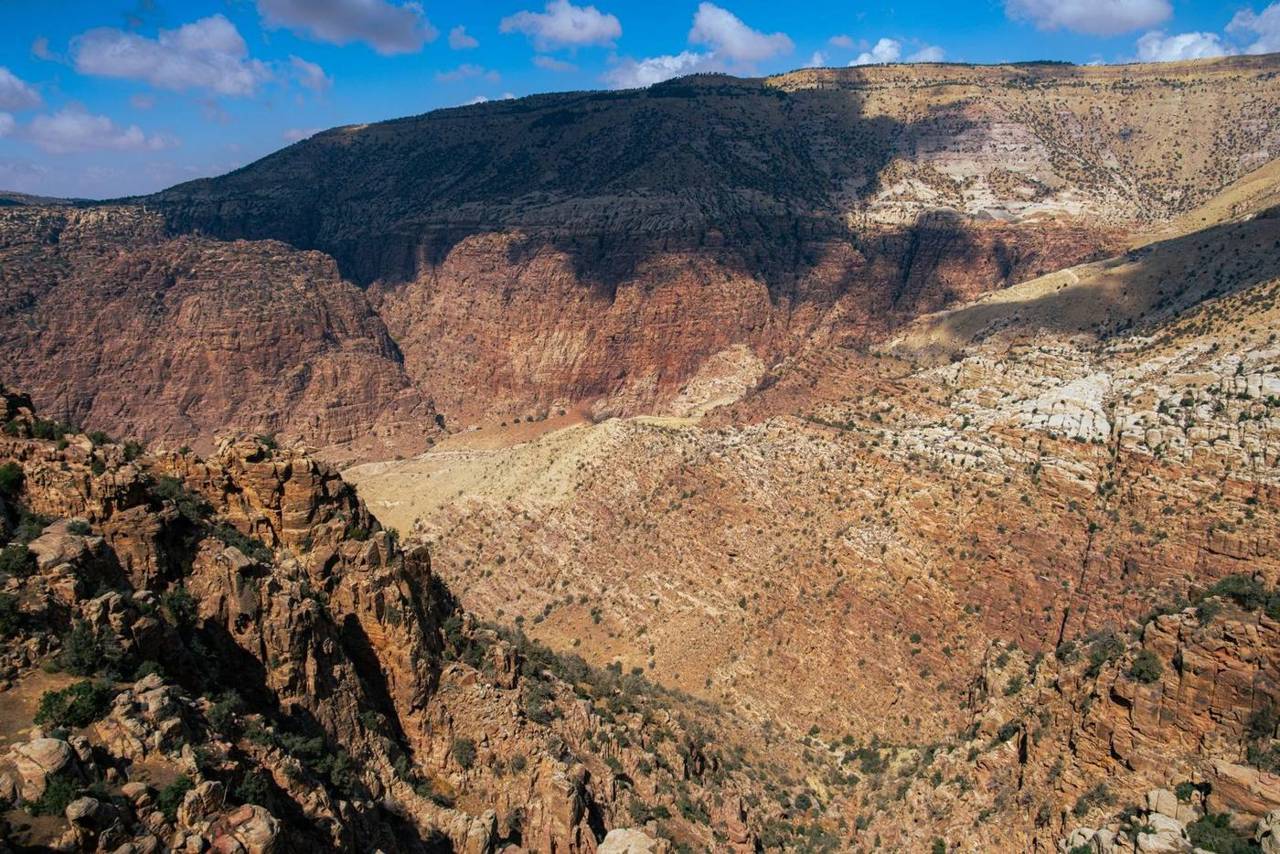
Eight days with your feet in the water, walking the gorges that drop from the plateau to the Rift Valley, with a single classic day at Petra.