The Whole of Jordan, from Amman to Aqaba
Two unhurried weeks: the Umayyad desert castles, the Jordan Valley, Dana, Petra, a night in Wadi Rum and the Red Sea to finish.
- Amman
- Iraq al-Amir
- Salt
- Castelli del deserto
- Madaba
- Dead Sea
- Dana
- Petra
- Wadi Rum
- Aqaba
Day by day
- Day 1
Arrival in Amman
This fifteen day trip is the whole of Jordan, without hurrying: Amman, Iraq al-Amir and Salt, the Umayyad desert castles of the east, Madaba, Mount Nebo and the baptism site, the Dead Sea, Dana, Little Petra and two full days in Petra, a night in Wadi Rum and the Red Sea at Aqaba.
Before you go: Italian citizens need a passport valid for at least six months from entry and a visa, applied for online on the Jordanian Ministry of Interior website or on arrival at Queen Alia airport. The Jordan Pass, bought only on the official website jordanpass.jo before you leave, costs 70, 75 or 80 dinars for one, two or three consecutive days in Petra, includes Wadi Rum and more than forty sites, and waives the visa fee if you stay at least two nights. Other nationalities should check their own rules.
Safety: with the regional conflict of 2026 Jordan has suffered missile and drone attacks, and flights can be cancelled suddenly. The UK advises against all travel within 3 kilometres of the Syrian border; the United States rates the country level 3 and asks travellers not to go near the Syrian border. This route does not go to the north and stays well away from the borders.
You land at Queen Alia airport, about half an hour from the city. Amman is built on many hills, with white limestone houses running down into the valleys.
In the late afternoon take a first stroll in the Balad, the old centre, among fruit stalls and coffee sellers.
Sleep in Amman, for four nights.
Practical tip: buy the Jordan Pass with two consecutive days in Petra, the right version for this trip.
- Day 2
The Citadel, the Roman Theatre and the souk
Today you discover Amman on foot, from the highest hill down to the old centre.
In the morning climb to the Citadel, on Jebel al-Qal'a, a hill inhabited for thousands of years. Here you see the columns of the Roman Temple of Hercules, with the fragments of a giant stone hand, the Umayyad palace with its rebuilt dome, a Byzantine church and a large ancient cistern. From the edge of the hill the view opens over the city's districts and the Roman theatre right below you.
Then walk down to the centre and visit the Roman Theatre, cut into the hillside in the second century, with steep tiers of seats climbing towards the sky. Next to it are the Odeon, a small theatre, and the Forum square. Both sites are in the Jordan Pass: check prices and times.
In the afternoon lose yourself in the Balad souk, among spices, dried fruit, olive oil soap and gold. Taste knafeh, the warm dessert of cheese and crisp pastry, and a sugar cane juice.
In the evening have falafel and hummus in one of the popular eateries of Downtown, where you eat at long rows of tables, with warm bread and raw vegetables.
Sleep in Amman.
Practical tip: at the souk always ask the price before buying and carry small notes, because sellers often have no change.
- Day 3
Iraq al-Amir and Salt
Today you leave Amman heading west, through green valleys and olive groves, to see two places that are almost always missing from short tours.
The first stop is Iraq al-Amir, less than an hour by road. The caves open in the valley walls, carved into the rock on several levels. A little further down stands Qasr al-Abd, a Hellenistic palace built with huge stone blocks and decorated with carved lions and eagles. According to ancient sources it was built by Hyrcanus, of the Tobiad family, in the second century BC. The site is in the Jordan Pass: check prices and times.
In the nearby village there is a women's workshop making paper, ceramics and textiles: watch them at work.
In the afternoon go up to Salt, a hill town built of yellow stone houses. At the end of the nineteenth century it was the most important town in the region, and merchants built mansions with arched windows and stairways. Since 2021 Salt has been a UNESCO World Heritage Site for its history of tolerance and hospitality. Walk along Hammam Street, the narrow, lively market, then climb the stairways between the houses. Visit the Salt Historical Museum, in a large mansion of that period.
In the evening return to Amman and have maqluba for dinner, rice with vegetables and chicken served upside down.
Sleep in Amman.
Practical tip: in Salt wear comfortable shoes, because the centre is all slopes and stone stairways.
- Day 4
Qasr Kharana and Azraq fortress
Today you head east, into the stony desert that stretches towards Iraq and Saudi Arabia, to see the desert castles.
The first stop is Qasr Kharana, about an hour from Amman. It is a square building with round towers that looks like a fortress from a distance. Inside there are two floors of rooms around a courtyard, with arches and stucco decoration. It was built at the beginning of the eighth century, in the time of the Umayyad caliphs, but even today nobody is sure what it was for: perhaps a meeting place with the Bedouin tribes. Check prices and times.
Then continue to the oasis of Azraq. Azraq fortress is built of black basalt blocks, with a great door made of a single slab of basalt. Here Lawrence of Arabia spent a winter during the Arab Revolt, in a room above the entrance. This fortress is also covered by the Jordan Pass, but check prices and times.
In the afternoon visit the Azraq Wetland Reserve, run by the RSCN, with wooden boardwalks among reed beds and pools. Many migratory birds stop here, especially in spring and winter.
In the evening have a simple dinner in the oasis, home to families of Druze, Chechen and Bedouin origin.
Sleep in Azraq.
Practical tip: in the eastern desert distances are long and petrol stations few, so fill up before leaving Amman and carry plenty of water.
- Day 5
Qusayr Amra and back to Amman
Today you return to Amman along the castle road and, if the group decides so, stop at Qusayr Amra.
Early in the morning take a last walk in Azraq, when the desert is cool and the light is soft.
Then set off west. Qusayr Amra is a small stone building in the middle of nowhere, with three low vaults and an Umayyad bathhouse from the early eighth century. From outside it looks modest, but inside the walls and ceilings are covered in frescoes: hunting scenes, musicians, dancers, craftsmen at work and, in the dome of the bath, a map of the sky with the constellations. It has been a UNESCO World Heritage Site since 1985 and is one of the rare examples of painting from that period. Entry is covered by the Jordan Pass; check prices and times before you set off.
If you prefer to skip the stop, you can return earlier and spend the afternoon at the Jordan Museum, in central Amman. Here you see the Ain Ghazal statues, among the oldest known human figures, and fragments of the Dead Sea Scrolls. Check prices and times.
In the late afternoon go up to Rainbow Street, in the Jebel Amman district, with cafés and terraces looking over the city.
In the evening have mansaf, the national dish of lamb cooked in dried yoghurt and served on rice.
Sleep in Amman.
Practical tip: inside Qusayr Amra the light is dim, so give your eyes a few minutes to adjust before looking at the frescoes.
- Day 6
Madaba and Mount Nebo
Today you leave Amman and head south to Madaba, the city of mosaics, about half an hour by road.
In the Greek Orthodox Church of Saint George you see the Madaba Map, a sixth century mosaic that depicts the Holy Land, with Jerusalem, its walls and its gates, the Jordan with its fish and the Dead Sea with its boats. It is the oldest known map of this region. Go in quietly, because the church is still used for services.
Then visit the Madaba Archaeological Park, with more Byzantine floors and a Roman road. The park is in the Jordan Pass: check prices and times.
In the afternoon climb Mount Nebo, the place from which, according to the Bible, Moses saw the Promised Land. In the memorial church there are Byzantine mosaics with hunting scenes and animals. From the terrace, on clear days, the view reaches the Jordan Valley and the Dead Sea. Check prices and times.
Back in Madaba, walk through the streets of the centre, among the workshops where mosaics are still made by hand, piece by piece.
In the evening have mezze, the starters for sharing: hummus, aubergine mutabbal, tabbouleh and stuffed vine leaves.
Sleep in Madaba.
Practical tip: Madaba is quieter than Amman and close to the airport, a good base even for anyone arriving late in the evening.
- Day 7
Bethany beyond the Jordan and the Dead Sea
Today you go down into the Jordan Valley, to the lowest point on earth.
In the morning go to Bethany beyond the Jordan, the baptism site, less than an hour from Madaba. According to Christian tradition, John the Baptist baptised Jesus here. The site has been a UNESCO World Heritage Site since 2015. The visit is made with the site's shuttle and guide: you walk among reeds and tamarisks to the remains of Byzantine churches, baptismal pools and the bank of the Jordan, which is narrow and slow here. Dress with shoulders and legs covered. Check prices and times.
Then continue to the Dead Sea, a few kilometres away. The shore lies more than four hundred metres below sea level and the water is so salty that you float without doing anything.
In the afternoon go for a swim. Go in slowly, do not wet your face, do not put your head under and take a fresh water shower straight afterwards. Try the black mud on your skin, then let it dry in the sun before washing it off.
At sunset watch the sun sink behind the hills on the other side of the lake: the water turns silver and then pink.
In the evening have a quiet dinner and enjoy the mild air, even in winter.
Sleep at the Dead Sea.
Practical tip: do not shave the day before your swim, because the salt stings on small cuts, and bring flip flops for the stones and salt crystals.
- Day 8
The King's Highway to Dana
Today you take the King's Highway, one of the oldest routes in the Middle East, and reach the Dana reserve.
From the Dead Sea you climb back to the plateau and join the road. Soon you reach the rim of the Wadi Mujib canyon, deep and wide, with hairpin bends that drop to the dam and climb up the other side. Stop at the viewpoints, because the view over the gorge is one of the finest on the road.
Around midday you reach Kerak, with its castle on the hill, a twelfth century Crusader fortress. Walk through the vaulted corridors and underground halls, then climb onto the walls to look at the valley. Check prices and times.
In the afternoon continue south, across farmed plateaus and villages, to Dana. The village of Ottoman era stone houses is built on the rim of the valley, with a view that opens for miles towards the Araba depression. Many houses have been restored and now welcome travellers.
At sunset the rocks of Wadi Dana turn red and the valley fills with shadows.
In the evening have a simple dinner of rice, chicken and vegetables at the village guesthouse.
Sleep in Dana, for two nights.
Practical tip: fill up before you set off, because petrol stations are few along the King's Highway, and allow plenty of hours for stops.
- Day 9
The trails of the Dana reserve
Today you walk in the Dana Biosphere Reserve, the largest nature reserve in the country, run by the Royal Society for the Conservation of Nature, the RSCN.
Within a few kilometres the reserve passes from limestone mountains to sandstone gorges and then to desert plains, with different plants and animals at every height. In the morning pay the reserve entrance and ask the RSCN which trails are open: some can be walked alone, others require a licensed guide, and several are seasonal. Choose a short trail on the plateau or along the rim of the valley, suitable for anyone who does not trek every day.
As you walk you may see junipers and oaks, Nubian ibex on the cliffs, birds of prey circling above the valley and Bedouin goat herds. Stop for tea with the guide, sitting on a rock, looking at the valley that drops towards Feynan.
In the afternoon rest in the village. Walk among the terraced gardens and old houses, and look at the workshops where local women prepare herbs, dried fruit and jams.
In the evening the sky above the valley is full of stars, because there are no cities nearby.
Sleep in Dana.
Practical tip: do not go down into the gorges if it is raining or rain is forecast on the plateau, because flash floods arrive within minutes; always carry at least two litres of water.
- Day 10
Little Petra at Siq al-Barid
Today you leave Dana and head for Petra, with a stop at Little Petra.
From Dana to Wadi Musa the road follows the plateau south, among hills and fields, and passes near the Crusader castle of Shobak, which you see on top of a hill. Allow an hour and a half or two hours with stops.
Little Petra, Siq al-Barid, is a few kilometres north of Petra. It is a narrow gorge between sandstone walls, with houses, storerooms, cisterns and banqueting halls cut into the rock. Caravans carrying incense and spices towards Petra stopped here. In one hall, on the ceiling, traces of paintings with vines, flowers and birds survive. The visit is short and peaceful, perfect to prepare for the days in Petra. Check prices and times.
In the afternoon go to Wadi Musa, the small town at the entrance to Petra, and settle in. If you have time, visit the Petra Museum, near the visitor centre, with Nabataean objects, statues and jewellery, to understand who built the city.
In the evening have mansaf or maqluba for dinner, and go to bed early: tomorrow you go in at opening time.
Sleep in Wadi Musa, for three nights.
Practical tip: go to Little Petra in the morning or late afternoon, when the light on the walls is warmer and visitors are few.
- Day 11
Petra, from the Siq to the Monastery
Today is your first full day in Petra, the ancient capital of the Nabataeans carved into pink sandstone, a UNESCO World Heritage Site.
Go in at opening time from the visitor centre. The first stretch descends towards the Siq, the narrow winding gorge more than a kilometre long, with towering walls and the remains of the channels that brought water into the city. At the end of the Siq, between the rocks, the Treasury appears: in the morning the light creeps in and the stone turns orange.
Continue along the Street of Facades, with tombs cut into the rock, to the theatre. Then climb to the Royal Tombs, on the right hand cliff: the Urn Tomb, the Silk Tomb with its coloured veins and the Corinthian Tomb. Go down to the colonnaded street, as far as the Great Temple and Qasr al-Bint.
In the afternoon tackle the climb to the Monastery, about eight hundred steps cut into the rock, among gorges and souvenir stalls. At the top the facade of the Monastery is even bigger than the Treasury. A few minutes higher up there are viewpoints over the Araba valley.
Head back towards the exit calmly: getting from the Monastery back to the visitor centre takes a couple of hours.
Sleep in Wadi Musa.
Practical tip: carry at least two litres of water, a hat and walking boots, because with the Monastery you easily cover more than twenty kilometres in a day.
- Day 12
Petra, the High Place of Sacrifice
Today you use the second day of your pass to see Petra from above, with fresh legs.
Go in again at opening time and walk the Siq, which is almost empty early in the morning. After the Treasury, before the theatre, take the path on the left to the High Place of Sacrifice. It climbs with steps cut into the rock, between red and white walls, to a platform on top of the mountain where the Nabataeans held their rites. You see the altar, the channels for liquids and two stone obelisks left standing in the rock. From the top the view opens over the tombs, the theatre and the valley.
Come down the other side, through Wadi Farasa. It is the quietest side of Petra: you pass the Lion Fountain, carved into the cliff, the Garden Tomb and the Tomb of the Roman Soldier, with its banqueting hall opposite. The path then reaches the colonnaded street.
In the afternoon rest in the shade or go back to see your favourite places from the day before in a different light. At sunset the Royal Tombs glow red.
In the evening, in Wadi Musa, drink a sage tea and look through the photos of the day.
Sleep in Wadi Musa.
Practical tip: the climb to the High Place of Sacrifice is steep and in the sun, so do it early, before the heat arrives, and keep your water close at hand.
- Day 13
Wadi Rum by jeep
Today you leave Petra and go down into the red desert of Wadi Rum.
In the morning set off south, about two hours by road. One stretch runs along the Desert Highway in Ma'an governorate: the United States asks travellers to reconsider the city of Ma'an and nearby areas, so travel by day and without stops. At the Wadi Rum visitor centre, a protected area and UNESCO World Heritage Site, you leave the car and climb into a four wheel drive with your Bedouin guide.
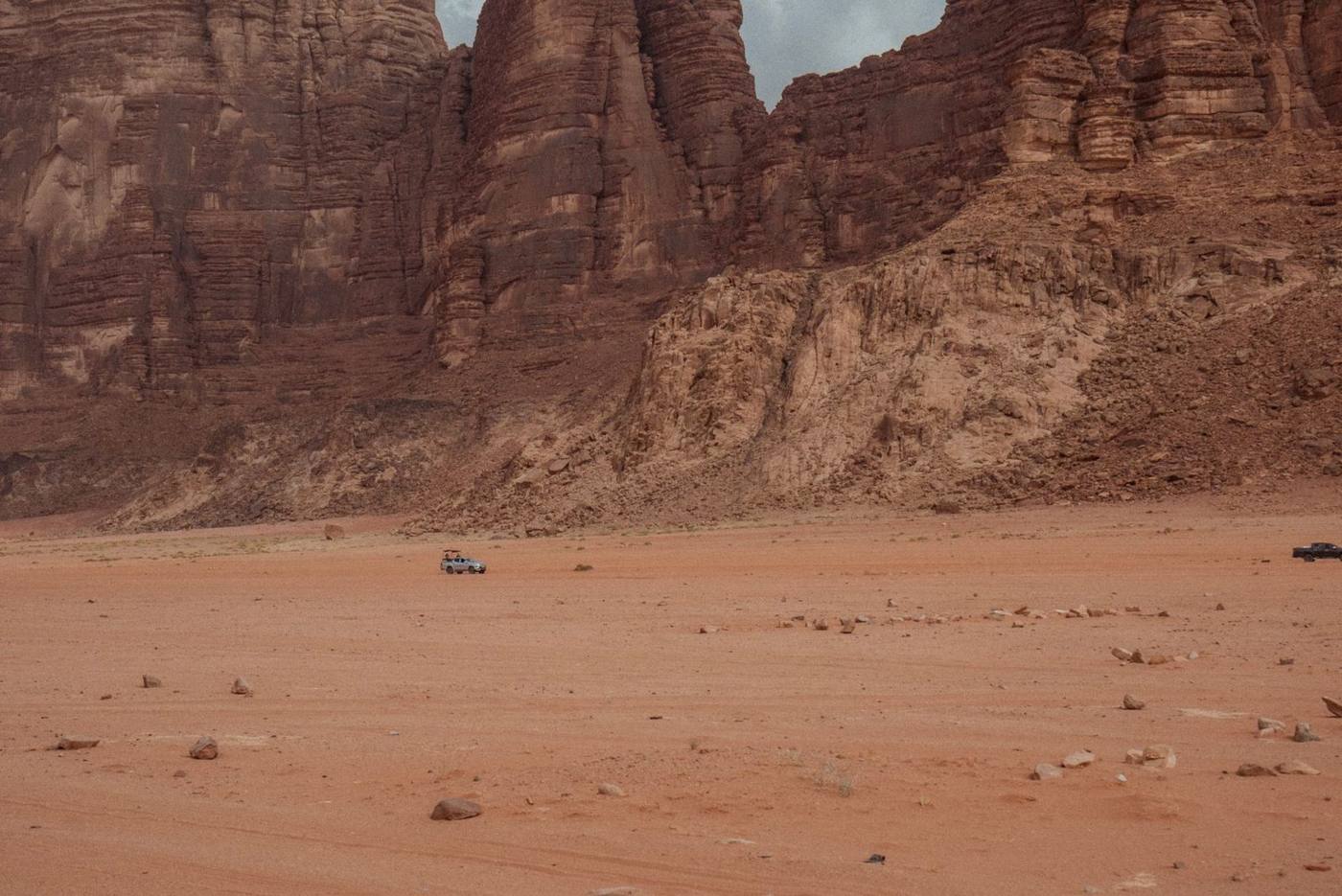
The tracks cross the red sand dunes, where you can run down barefoot, and lead among sandstone and granite mountains with walls that rise straight from the desert. You see Khazali Canyon, a narrow cleft in the rock with Nabataean and older carvings on its walls, the spring linked to Lawrence of Arabia and one of the natural rock arches, which you climb carefully and only with the guide.
At sunset climb a high dune and watch the light on the cliffs: red turns orange and then purple.
In the evening have a Bedouin dinner of zarb, meat and vegetables cooked in an oven under the sand, then tea around the fire. At night the Wadi Rum sky is full of stars.
Sleep in a tented camp in Wadi Rum.
Practical tip: bring a warm jacket and a hat, because at night the desert temperature drops sharply, especially between November and February.
- Day 14
Aqaba and snorkelling in the Red Sea
Today you leave the sand and go down to the sea, to Aqaba, Jordan's only city on the Red Sea.
Wake up early to watch dawn over the desert, then set off: from Wadi Rum to Aqaba it is about an hour by road. The city lies at the head of the Gulf of Aqaba, with mountains behind it and warm water for most of the year, even in December.
South of the centre, along the coast, the coral reef begins, protected by a marine park. You only need a mask, snorkel and fins: you go in from the beach and after a few metres you see hard and soft corals, clownfish in the anemones, butterflyfish, parrotfish and, with a little luck, a turtle. Anyone who is not a strong swimmer can see the reef from a glass bottomed boat.
In the afternoon visit Aqaba Castle, a fortress near the seafront, then stroll through the centre among spice markets and date shops. The castle is in the Jordan Pass: check prices and times.
At sunset watch the sun go down over the gulf, with the lights of the nearby coasts coming on one by one.
In the evening have grilled Red Sea fish and sayadieh, rice with fish and golden onions.
Sleep in Aqaba.
Practical tip: do not touch the corals or walk on the reef, use reef friendly sun cream and bring water shoes.
- Day 15
Back to Amman and departure
Today is the day you go home.
From Aqaba to Amman there are two options: a short domestic flight, or about four hours by road on the Desert Highway, which runs through Ma'an governorate. By car leave early, travel by day and stop only at service areas. Allow a generous margin before your return flight from Queen Alia airport.
Trip summary: in fifteen days you have seen the whole of Jordan. In Amman you climbed to the Citadel and wandered through the souk, at Iraq al-Amir you saw a Hellenistic palace and in Salt the yellow stone houses. In the eastern desert you visited Qasr Kharana, the black fortress of Azraq and the frescoes of Qusayr Amra. In Madaba you saw the mosaic map, from Mount Nebo the Jordan Valley, at Bethany the bank of the river, and you floated in the Dead Sea. You drove the King's Highway to Dana, saw Little Petra, the Treasury, the Monastery and the High Place of Sacrifice, slept in Wadi Rum and swam over the reef at Aqaba.
When to go: the best months are March to May and October to December, with mild days and cool evenings. There is also a departure over New Year: Amman, Dana and Petra are cold and it can rain, while the Dead Sea and Aqaba stay mild. In summer Petra, Wadi Rum and the Dead Sea are very hot.
Practical tip: get to the airport well in advance and check your flight status, because with the regional situation schedules can change.
This is the trip for those who want to see Jordan once and properly, with time to linger: the desert castles, Salt and Iraq al-Amir are usually missing from shorter programmes. The drawback is length, as fifteen days is a lot for a small country and some transfer stretches drag. Buy the Jordan Pass, which covers Petra, online before you go, and check the current travel advice from your foreign ministry.
Before you go
- Documents and visa
- Passport valid for at least six months from entry and a tourist visa, applied for online on the Jordanian Ministry of Interior website or on arrival at Queen Alia airport in Amman, paid in dinars. The Jordan Pass, bought only on the official website jordanpass.jo before arrival, covers the visa fee if you stay in Jordan for at least three nights and includes Petra, Jerash, Wadi Rum and more than forty sites.
- Health and vaccines
- No compulsory vaccinations: ask your doctor about recommended ones at least eight weeks before. Protect yourself from the sun and drink plenty of water, above all in the desert and the canyons. Outside Amman and Aqaba medical facilities are basic: you need insurance with medical costs and repatriation. Emergencies: 911.
- Money and payments
- Jordanian dinar. Cards work in cities and hotels; keep cash for villages, the desert and tips.
- Power sockets
- Mixed sockets for type A and C plugs, often also F and G, 230 volts: bring a universal adapter.
- Time zone
- UTC+3 all year.
- Safety
- With regional tensions and the missile and drone attacks of 2026, the United States rates Jordan level 3 and the UK advises against all travel within 3 km of the Syrian border. Do not go near the borders with Syria and Iraq, the refugee camps, Zarqa or Rusayfah; avoid the city of Ma'an. Flights and airspace can close without notice. In the canyons there is a risk of flash floods: follow the reserves' closures. Official advice: GOV.UK.
Information checked in November 2026 for Italian and EU citizens. Rules change: always check before you travel.
Variations
In ten days you can drop the desert castles and Iraq al-Amir and spend a single day in Petra.
In eighteen days you can add Jerash, a second night in Wadi Rum and a day's trek from Dana to Feynan with a guide.
Frequently asked questions
Is the Jordan Pass worth it for this trip?
Yes: it waives the visa fee if you stay at least two nights and includes Petra, Wadi Rum, the Amman Citadel and Roman Theatre, Iraq al-Amir, Qasr Kharana, Qusayr Amra, Azraq fortress and the Madaba Archaeological Park. Buy it only on the official website jordanpass.jo, before you leave.
Does the trip go near the areas to avoid?
No. The UK advises against travel only within 3 kilometres of the Syrian border, and this route does not go to the north. Before booking, still check Viaggiare Sicuri and your flight status.
Are fifteen days too many for Jordan?
They are a lot for a small country, and some transfers feel long. In return you see at a calm pace places that short tours skip, such as the desert castles, Salt and Iraq al-Amir.
Indicative itinerary written by World Atlas. Before booking, check timetables, seasonal openings, documents and safety.
 9 daysEasy
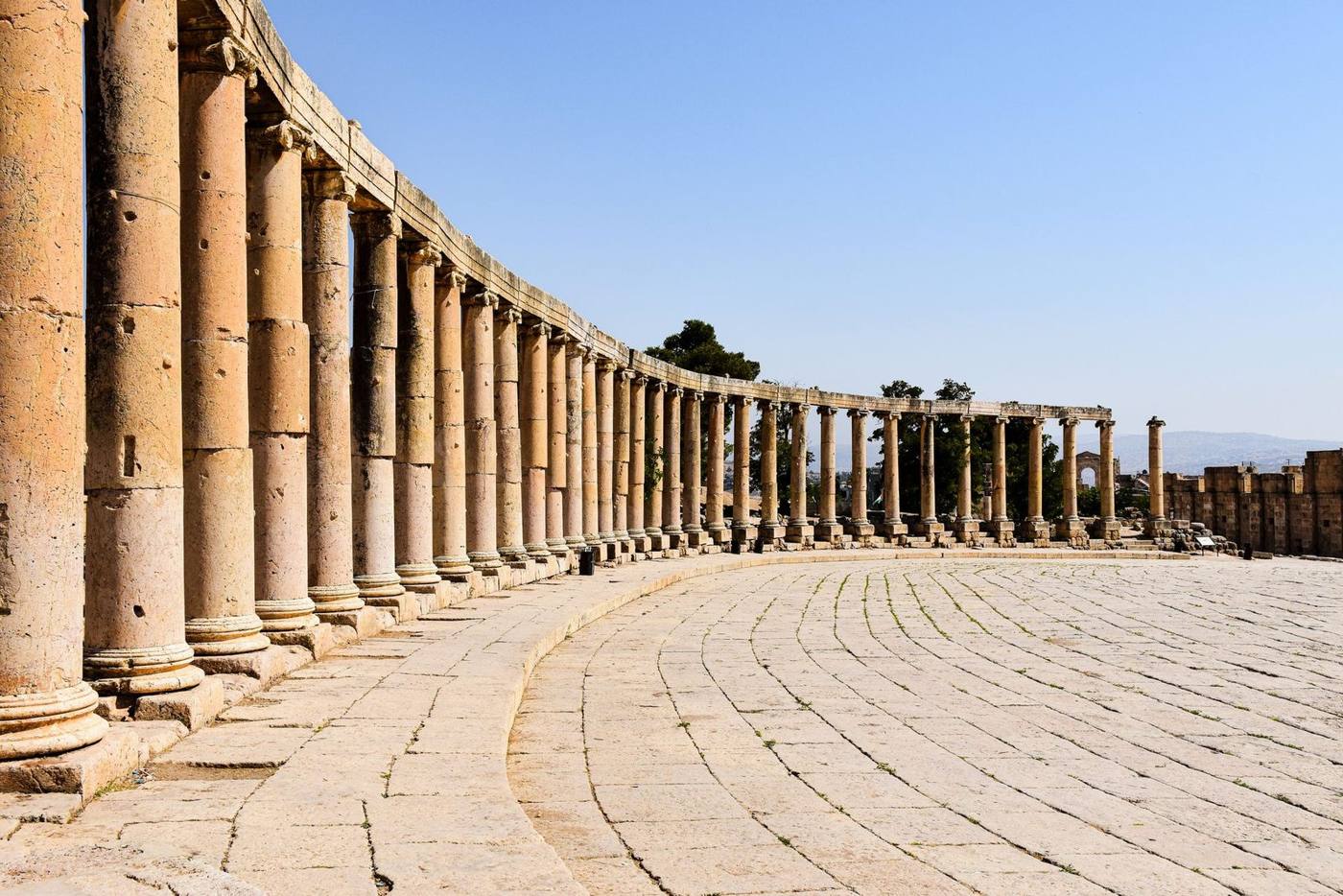
Jerash, Madaba and the King's Highway
Classic Jordan in nine days, with the Roman city of Jerash, Byzantine mosaics, the Crusader castle of Shobak and the Wadi Mujib canyon in season.
 8 daysChallenging
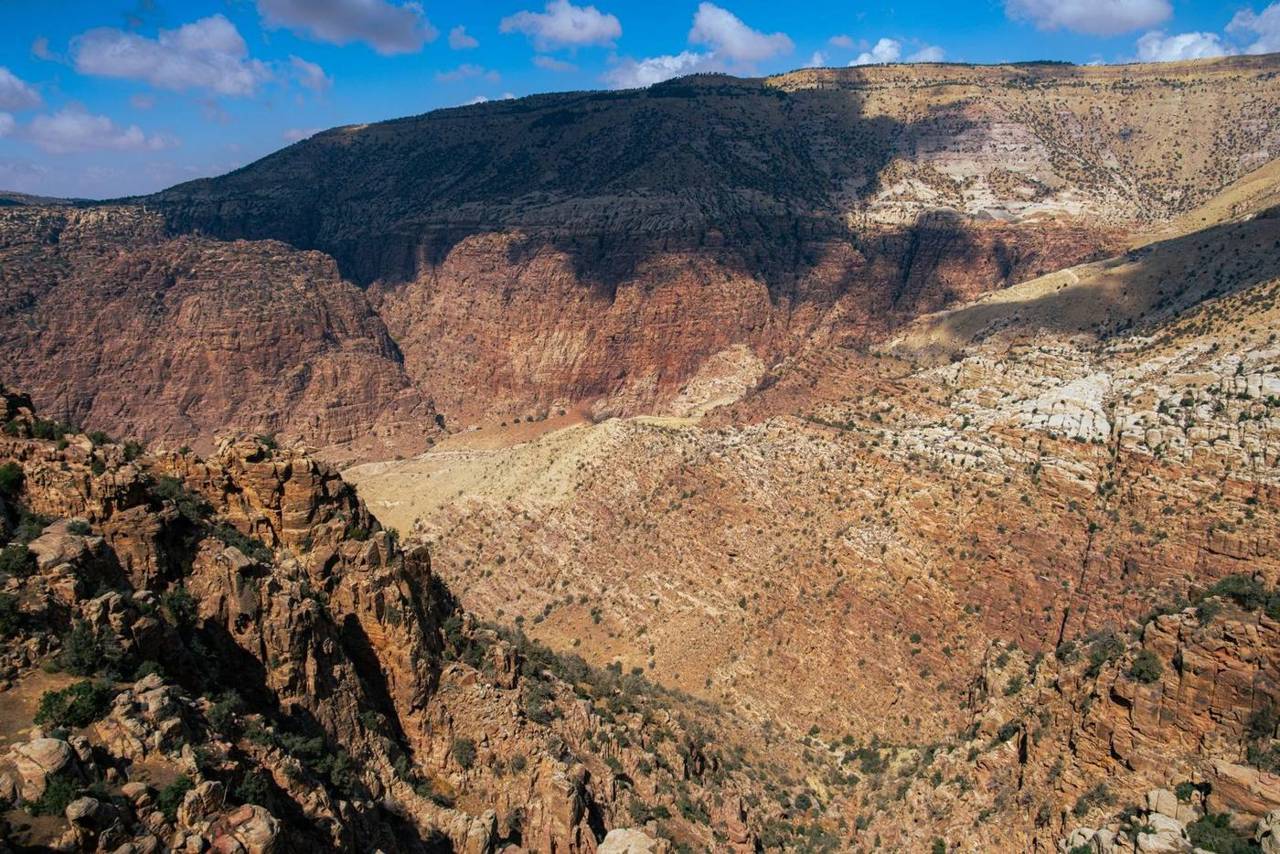
The Canyons of Jordan: Mujib, Hasa and Ghuwayr
Eight days with your feet in the water, walking the gorges that drop from the plateau to the Rift Valley, with a single classic day at Petra.
 7 daysModerate
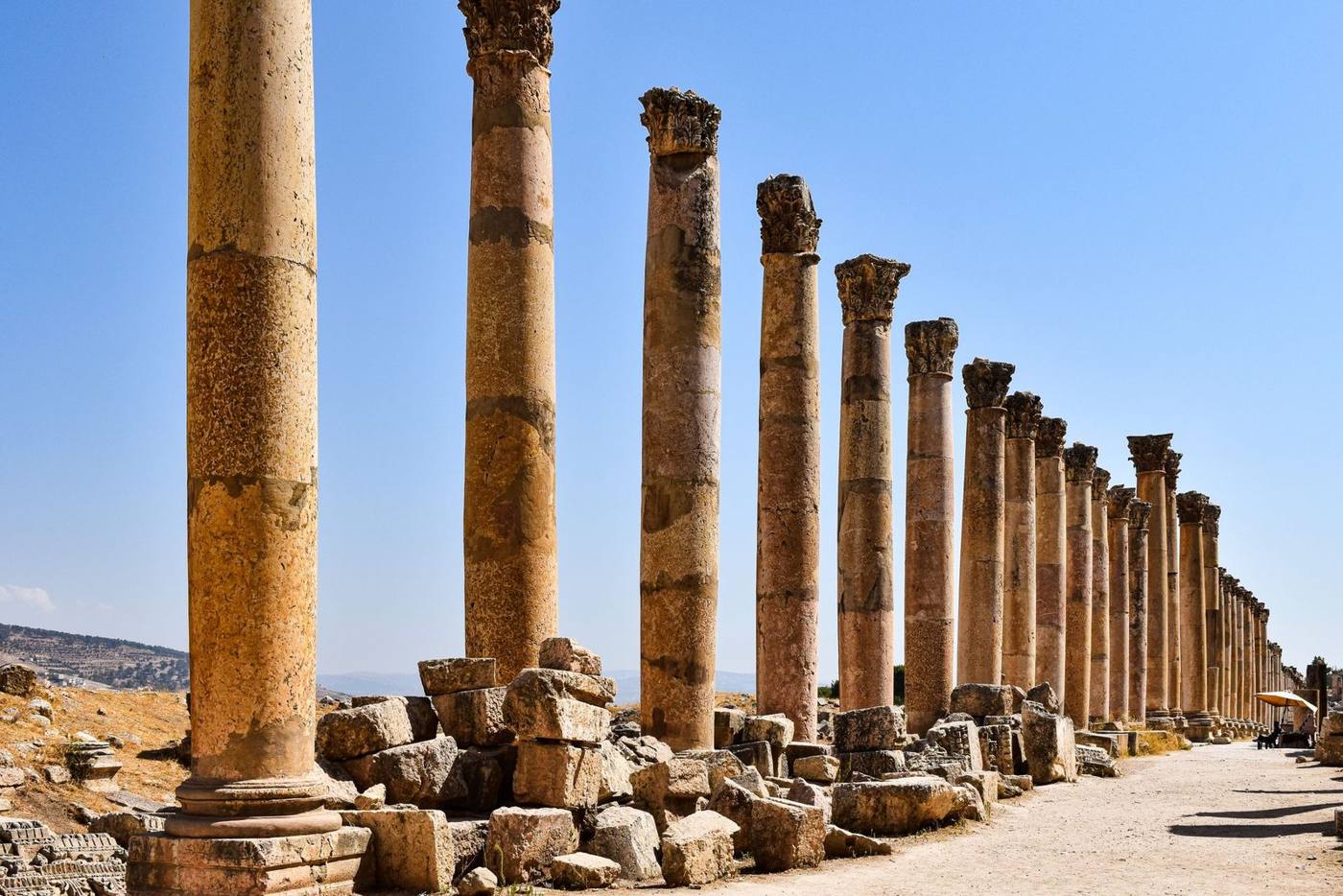
The North on Foot, from Umm Qais to Salt
The first stages of the Jordan Trail through olive groves, oak woods and farming villages, in the green Jordan few people picture, with Jerash halfway.