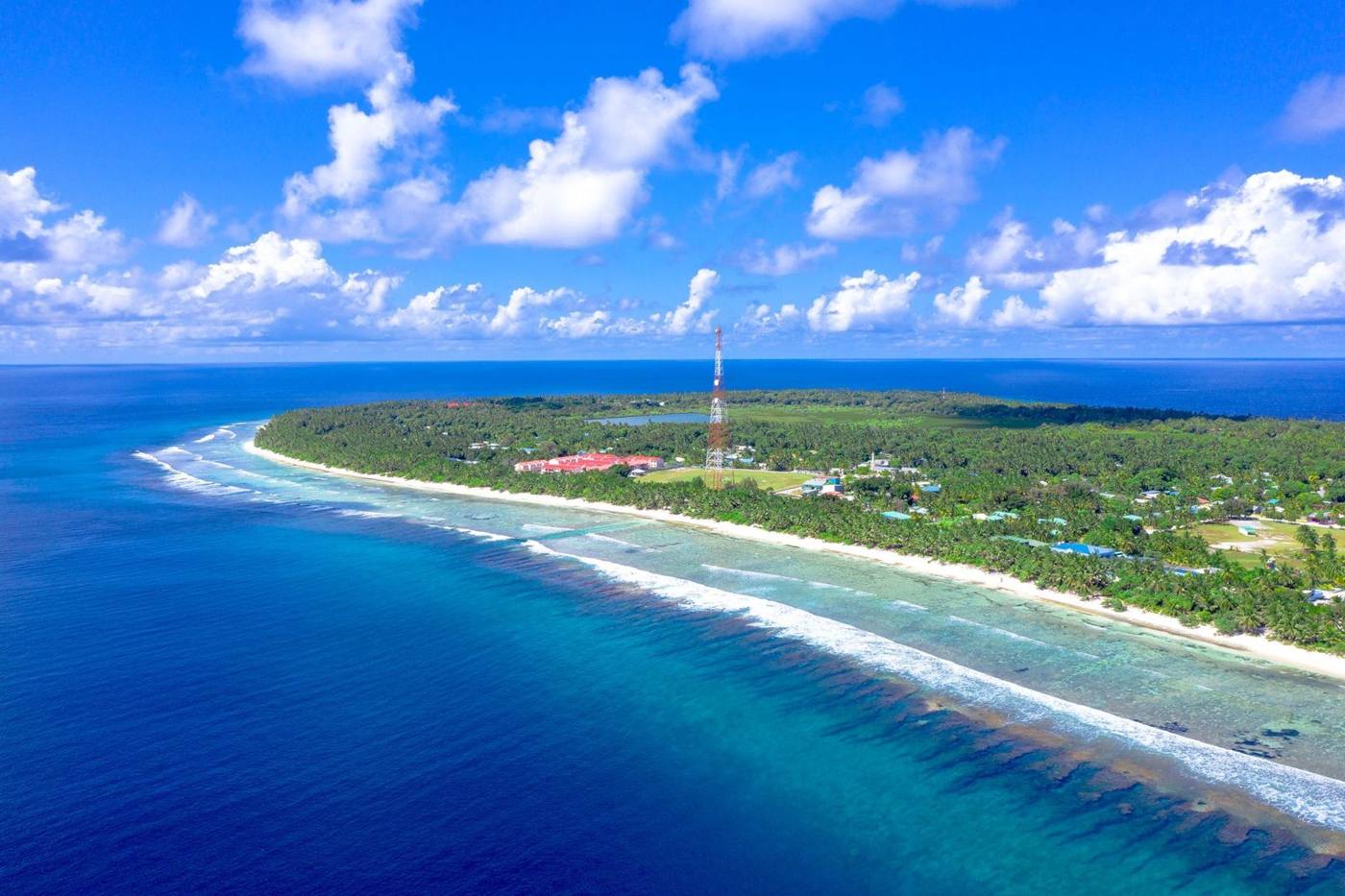
Funafuti
The capital atoll, the airstrip that becomes a playground in the evening and the Funafuti Conservation Area with its islets and lagoon.
- Fongafale
- Funafuti airstrip
- Funafuti Conservation Area
Day by day
- Day 1
Arrival in Fongafale
This four-day trip takes you to Funafuti, the capital atoll of Tuvalu, one of the least visited countries in the world and among the most threatened by climate change: a thin ring of sand and coral islands, a few metres above sea level, around a large lagoon.
Before you go: Italian citizens enter Tuvalu with a passport valid for at least six months from the date of arrival. The Italian foreign ministry says the visa must be requested from the Tuvalu Immigration Office: write before you go to find out the current rules; visitors can usually stay for up to one month. Other nationalities should check their own rules. You can only get there via Fiji, with a few flights a week from Suva, which can be cancelled because of bad weather: leave spare days before your return flight. From November to April there is a risk of cyclones and storm surges. Health facilities are very limited: you need insurance that also covers evacuation.
You land on the Funafuti airstrip, which takes up much of the width of Fongafale, the main island. The small airport is a few steps from the centre: here almost everything can be reached on foot or by scooter.
In the afternoon walk along the island: on one side the calm, turquoise lagoon, on the other the ocean breaking on the reef, sometimes only a few dozen metres apart.
At sunset go back to the airstrip: when there are no flights it becomes everyone's backyard, with football and volleyball games, children on bicycles and families sitting in the cool.
Sleep in Fongafale, for three nights.
Practical tip: bring all your cash in Australian dollars: cards are hardly used.
- Day 2
By boat to the Funafuti Conservation Area
Today you cross the lagoon by boat to the Funafuti Conservation Area, the protected area on the western side of the atoll, with uninhabited islets, coral reefs and clear water.
The trip is arranged in Fongafale, through the conservation area office or with local boatmen: ask the day before and agree the price and the return time. Check prices and times. Crossing the lagoon takes a while and, with wind, the water can be choppy.
You land on islets of white sand covered in palms and shrubs, where seabirds such as terns and boobies nest. Walk slowly and keep away from the nests.
Snorkel near the shore: among the corals swim parrotfish, surgeonfish, small reef sharks and sometimes sea turtles. Fishing is banned in the protected area and marine life is much richer than near Fongafale.
Bring everything you need: water, food, sun cream, a hat and reef shoes. There is nothing on the islets and the only shade is under the palms.
In the afternoon, before the wind gets up, go back to Fongafale.
If the weather allows, stop to look at the lagoon from the tip of an islet: from here you see the water change colour from pale green to deep blue, and you understand how fragile this atoll is.
Sleep in Fongafale.
Practical tip: do not take away shells or coral: they are protected and help keep the islets alive.
- Day 3
The islets and life on the atoll
Today you have two options: go back to the Conservation Area to explore other islets, or discover everyday life on Fongafale.
If you choose the sea, ask to be taken to a different islet from yesterday and spend the day snorkelling, on the sand and in silence. Each islet is different: some have long tongues of sand that appear at low tide, others are covered in thick vegetation.
If you stay on land, hire a scooter or a bicycle and ride Fongafale from one end to the other. You will see family homes with tin roofs, churches, the government building, the harbour with boats arriving from the outer islands, and the point where the island is so narrow that you can see the ocean and the lagoon together.
During the Second World War the United States built an air base here: today's airstrip grew out of it. In some places on the island the marks of those years can still be seen.
Talk to local people: many explain how the highest tides now reach roads and gardens, and how the country is trying to protect its islands.
In the evening taste fresh lagoon fish cooked in coconut milk, and pulaka, a large root grown in pits dug into the ground.
Sleep in Fongafale.
Practical tip: dress modestly in villages and in church, and on Sunday respect the day of rest.
- Day 4
Departure
Today is the day you leave. The flight to Suva leaves from the Fongafale airstrip: get to the airport early and check the evening before that the flight is confirmed.
If your flight is in the afternoon, take a last walk by the lagoon early in the morning, when the light is soft and the fishermen go out in their canoes.
Before leaving, buy a small piece of local craft, such as a fan or a woven mat, made by the women of the islands.
Trip summary: in four days you have got to know Funafuti, the capital atoll of Tuvalu, seen the airstrip that becomes everyone's playground in the evening, explored by boat the islets and reefs of the Funafuti Conservation Area and discovered life in one of the smallest and most remote countries in the world.
When to go: from May to October, when it rains less and the sea is calmer. From November to April it is hotter, it rains more and there are cyclones and storm surges, which can also stop flights.
Remember that in Tuvalu everything depends on the flight: if it is cancelled, you may have to stay a few more days. That is why it is important to have a changeable ticket and insurance that also covers these cases.
Practical tip: book your flight home from Fiji at least one or two days after you arrive back from Tuvalu.
One of the least visited countries in the world and among the most threatened by climate change. Few weekly flights from Suva. Very few, simple places to stay, to be booked ahead.
Before you go
- Documents and visa
- Passport valid for at least six months from the date of arrival. You can only get there via Fiji. The Italian foreign ministry says the visa must be requested from the Tuvalu Immigration Office: write before you go to find out the current rules. Visitors can usually stay for up to one month.
- Health and vaccines
- Health facilities are very limited: serious cases need evacuation, so travel with insurance that covers medical costs and repatriation. There are cases of dengue: use repellent. Drink only bottled water and eat well-cooked food. A yellow fever certificate is needed only if you arrive from an area at risk. Emergencies: 911.
- Money and payments
- Australian dollar, with Tuvaluan coins. Cards are hardly used: bring all the cash you need, in Australian dollars.
- Power sockets
- Type I, 220-240 volts: you need an adapter for European plugs.
- Time zone
- UTC+12 all year.
- Safety
- Crime is among the lowest in the Pacific, but keep an eye on your belongings. There are only a few flights a week from Suva, and they can be cancelled because of bad weather: leave spare days. Cyclones and storm surges from November to April. Strict drug laws. Official advice: GOV.UK.
Information checked in November 2026 for Italian and EU citizens. Rules change: always check before you travel.
Variations
Shorter version: three days, with a single trip to the Conservation Area.
Longer version: if ship schedules allow, add a trip to an outer island, but with many spare days.
Frequently asked questions
How do you get to Tuvalu?
Only by plane from Fiji, with a few flights a week from Suva. Flights can be cancelled because of bad weather: always leave spare days.
Do I need a visa for Tuvalu?
The Italian foreign ministry says it must be requested from the Tuvalu Immigration Office. Write before you go to find out the current rules; you can usually stay for up to one month.
Is there accommodation on Funafuti?
Very little, and simple, almost all on Fongafale. Book before you leave and bring cash in Australian dollars.
Indicative itinerary written by World Atlas. Before booking, check timetables, seasonal openings, documents and safety.